
Product
Enterprise SaaS
Timeline
2026
Project
Voice Hotline: Accessible Civic Feedback System
Role
Lead Product Designer
Overview
Voice Hotline for Social Point is a phone-based feedback system that allows community members to leave recorded voice submissions through a dedicated hotline number. These recordings are automatically transcribed and stored as structured engagement records within the Social Point platform. The tool is designed for government agencies running public consultations, where accessibility and inclusion are critical. It enables participation from communities who may not engage through digital channels, including seniors, ESL communities, rural populations, and people with disabilities, ensuring feedback collection is more equitable. For internal teams, it brings voice feedback into a centralised system of record, allowing it to be reviewed, analysed, and reported alongside other engagement channels in SP.
The Challenge
Public consultation platforms are typically built around digital-first assumptions, which creates an inherent accessibility gap in participation. While voice feedback is commonly used in government workflows, it is often handled through fragmented systems such as voicemail, call centres, or manual transcription processes, resulting in inconsistent data quality and limited auditability. This leads to feedback that is not easily structured, tracked, or integrated into broader engagement reporting, and creates operational overhead for teams managing multiple disconnected channels. The system also needed to meet strict constraints around regulatory compliance, FOIA audit requirements, multilingual support, and transcription trustworthiness, while operating at scale across multiple projects and jurisdictions. The core challenge was to transform voice input — traditionally unstructured and operationally heavy — into a reliable, governed, and scalable data channel fully integrated within a civic engagement platform.
My Role
I was the end-to-end Lead Product Designer for the Voice Hotline feature, responsible for shaping the experience from early concept and system design through to detailed UX flows and interaction design. I worked across the full product lifecycle — including problem framing, IA and workflow design, IVR experience design, edge-case handling, and reporting structure definition — while collaborating closely with product, engineering, and stakeholders. I also used Claude as part of my design workflow to accelerate system exploration, pressure-test complex logic, and refine edge cases across the telephony and transcription experience.
Tools

Research
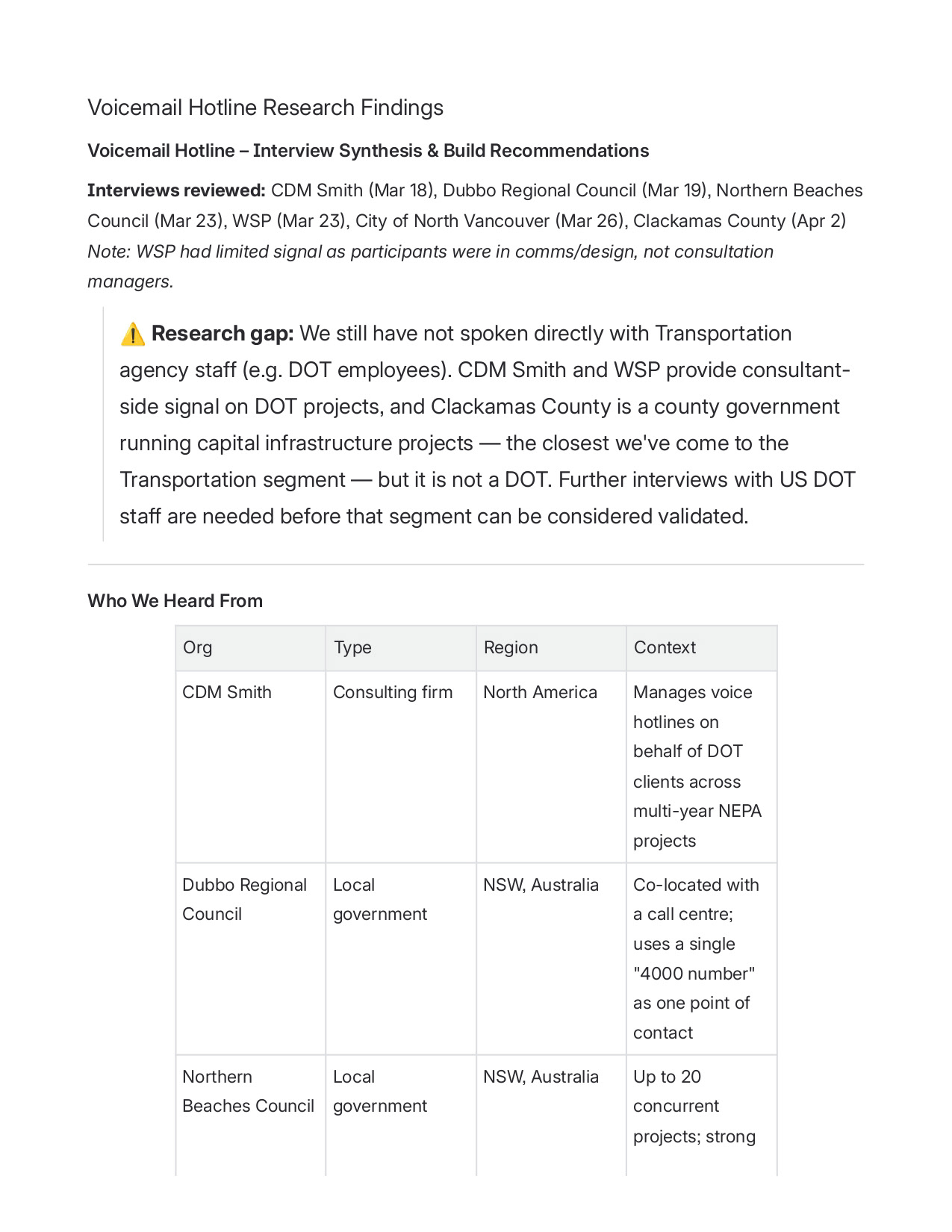
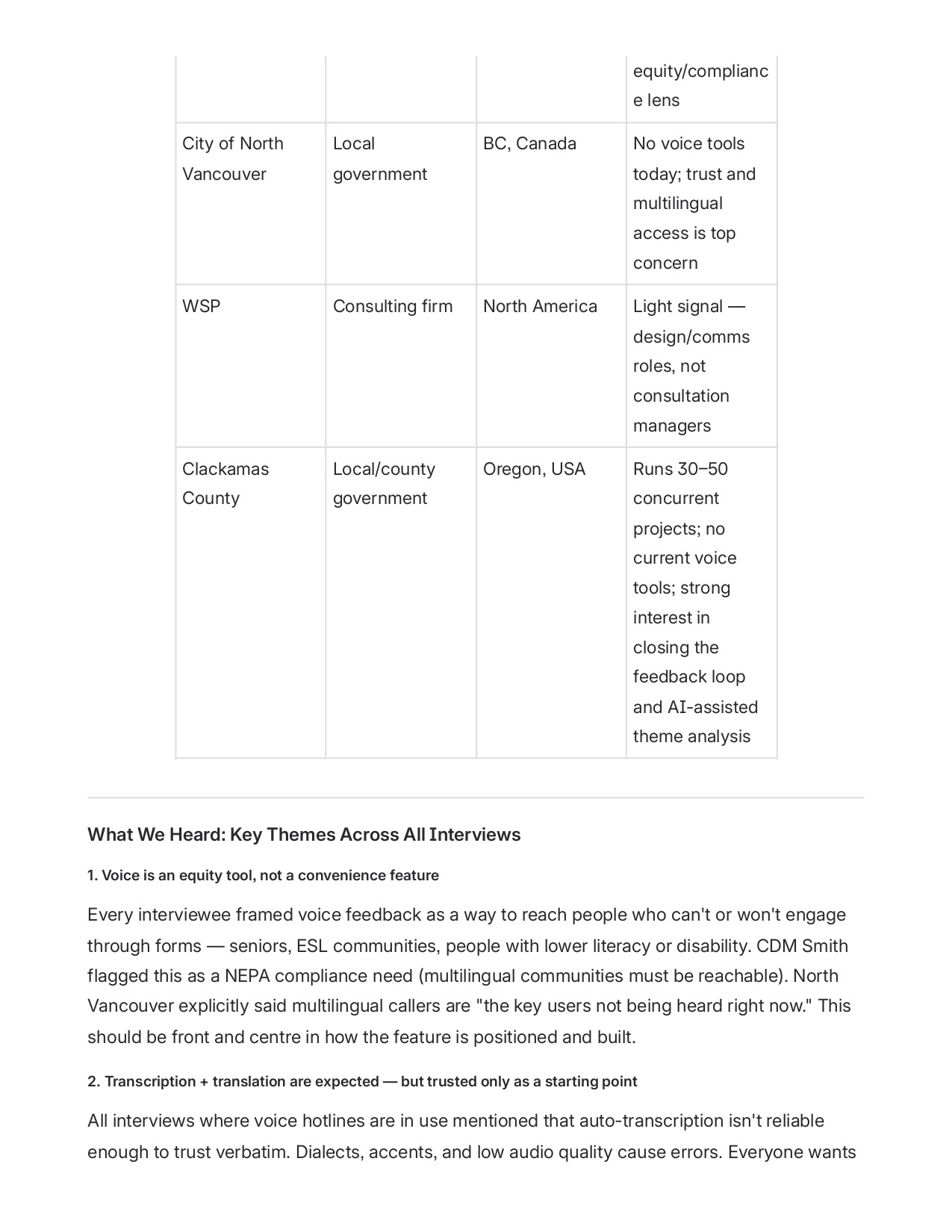
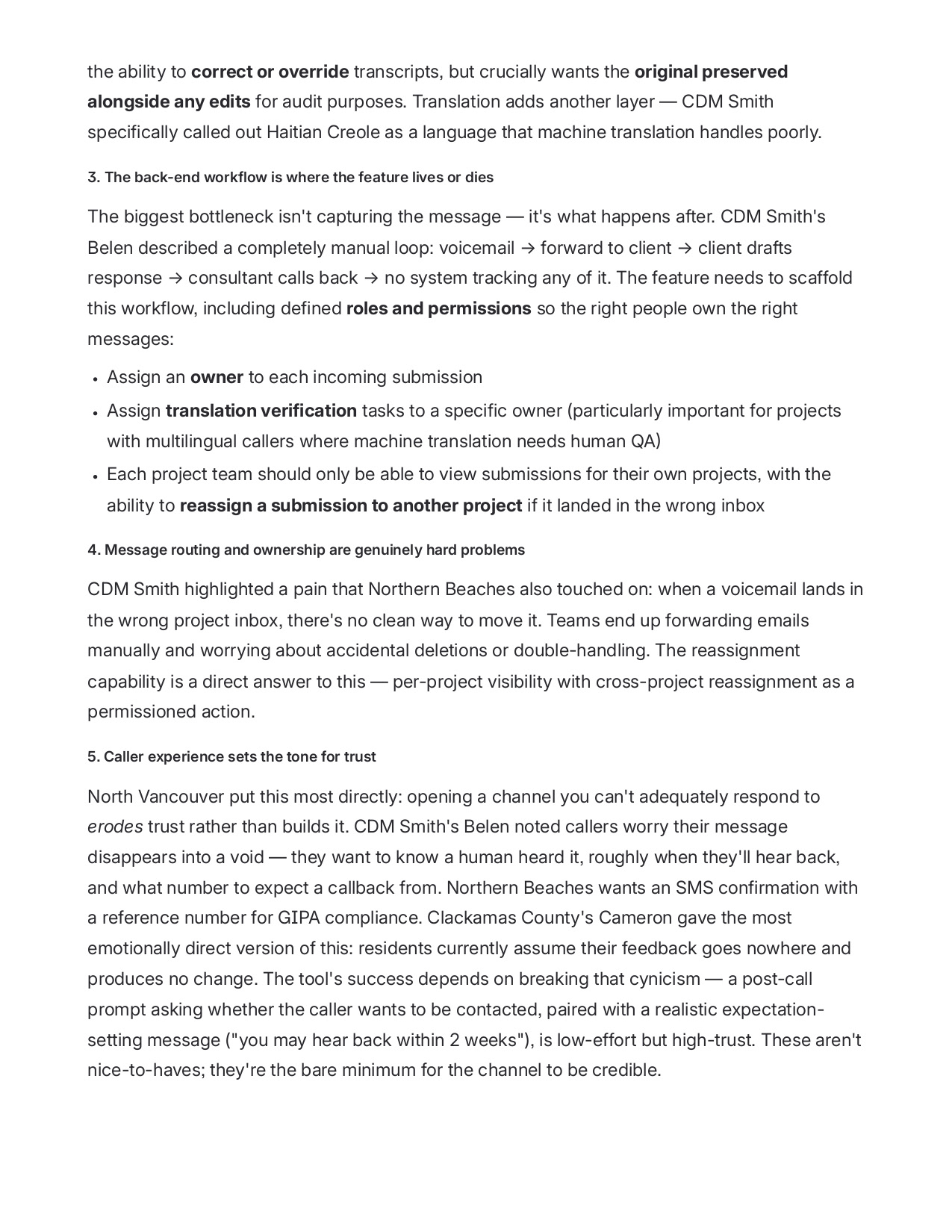
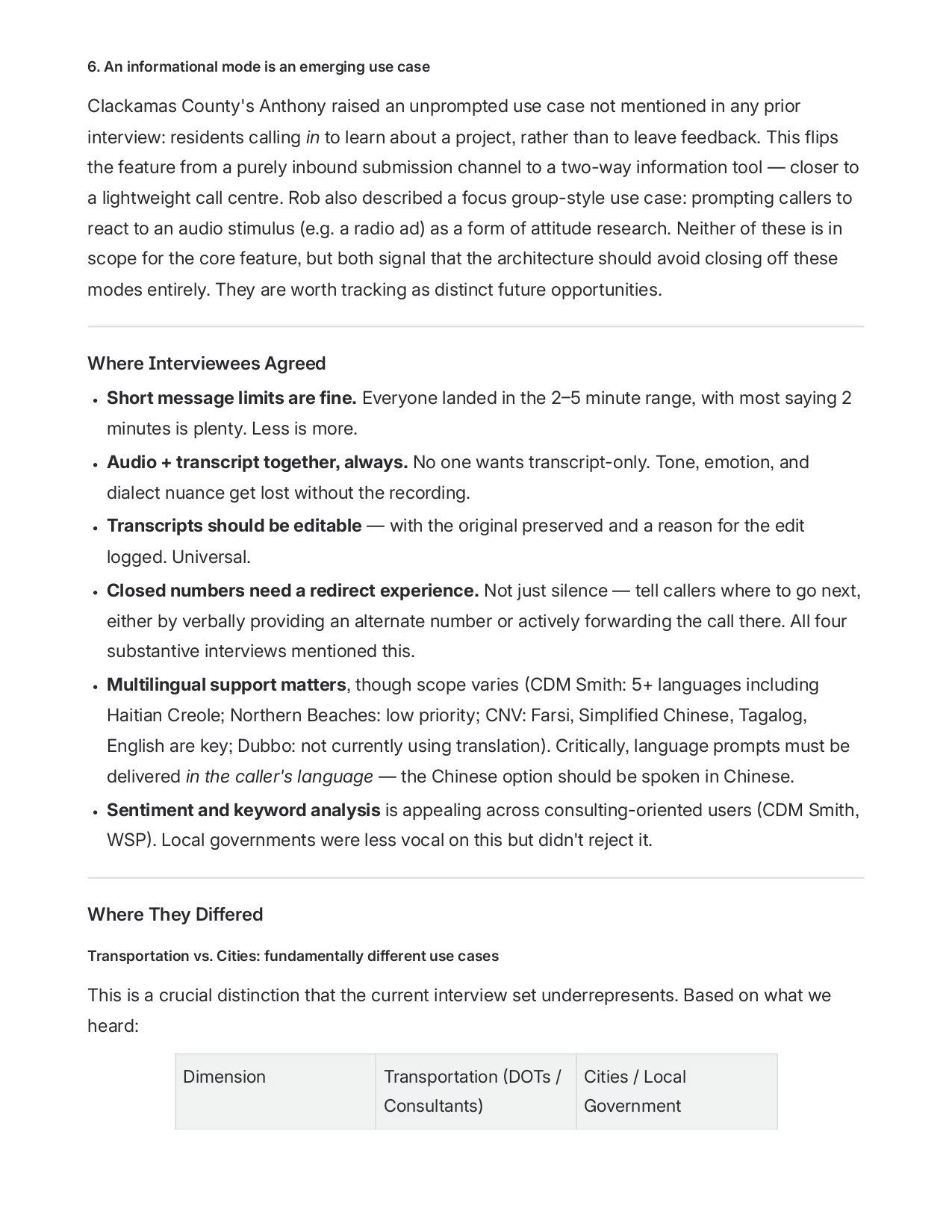
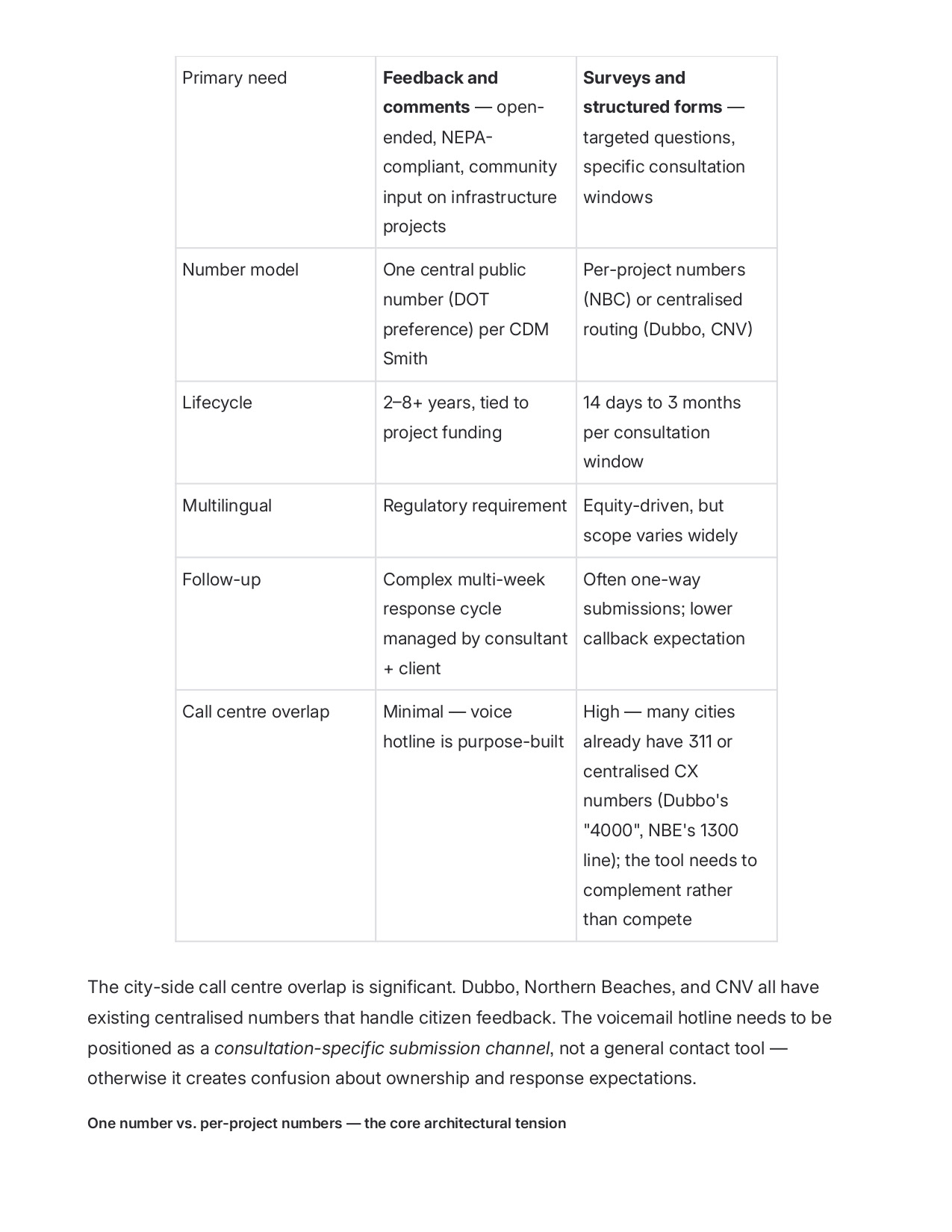
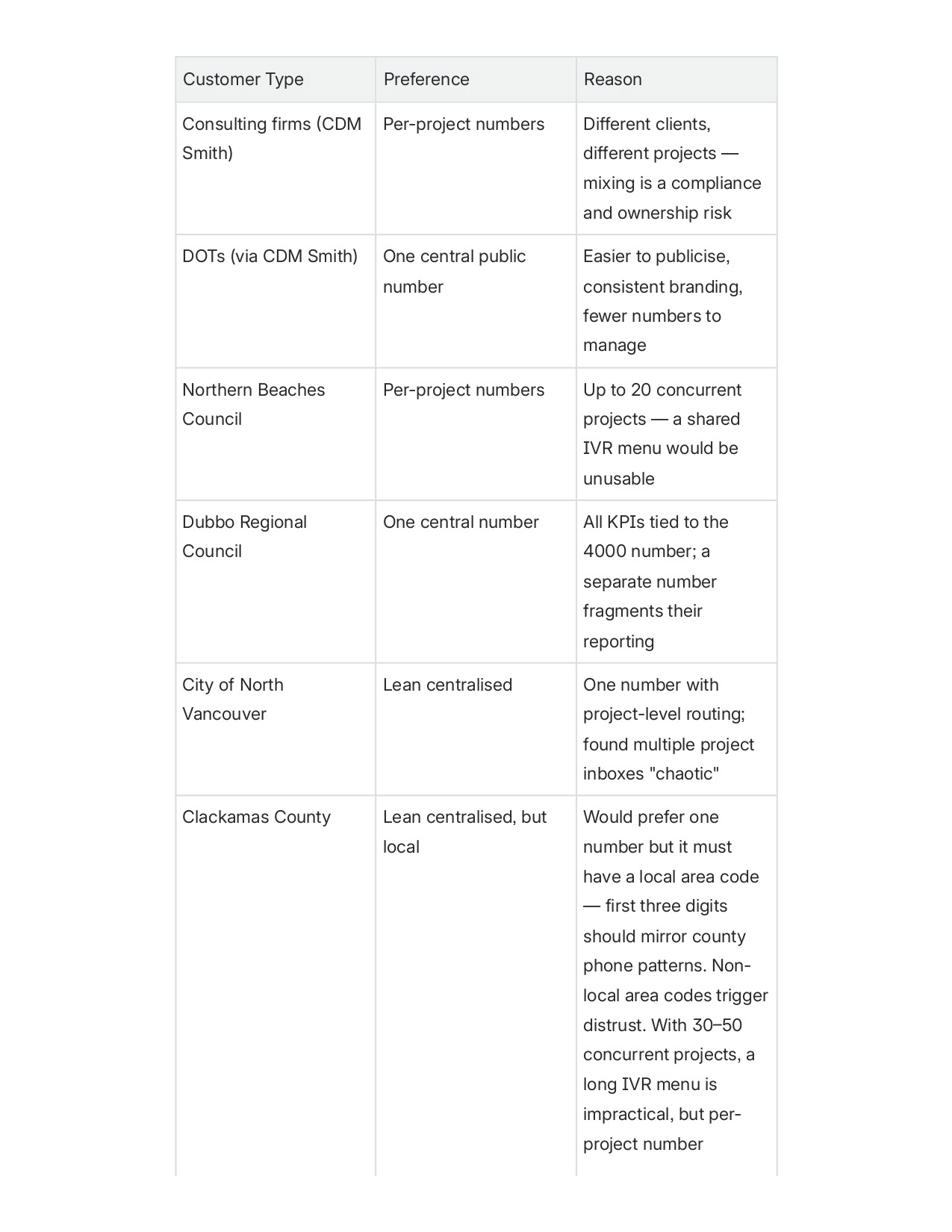
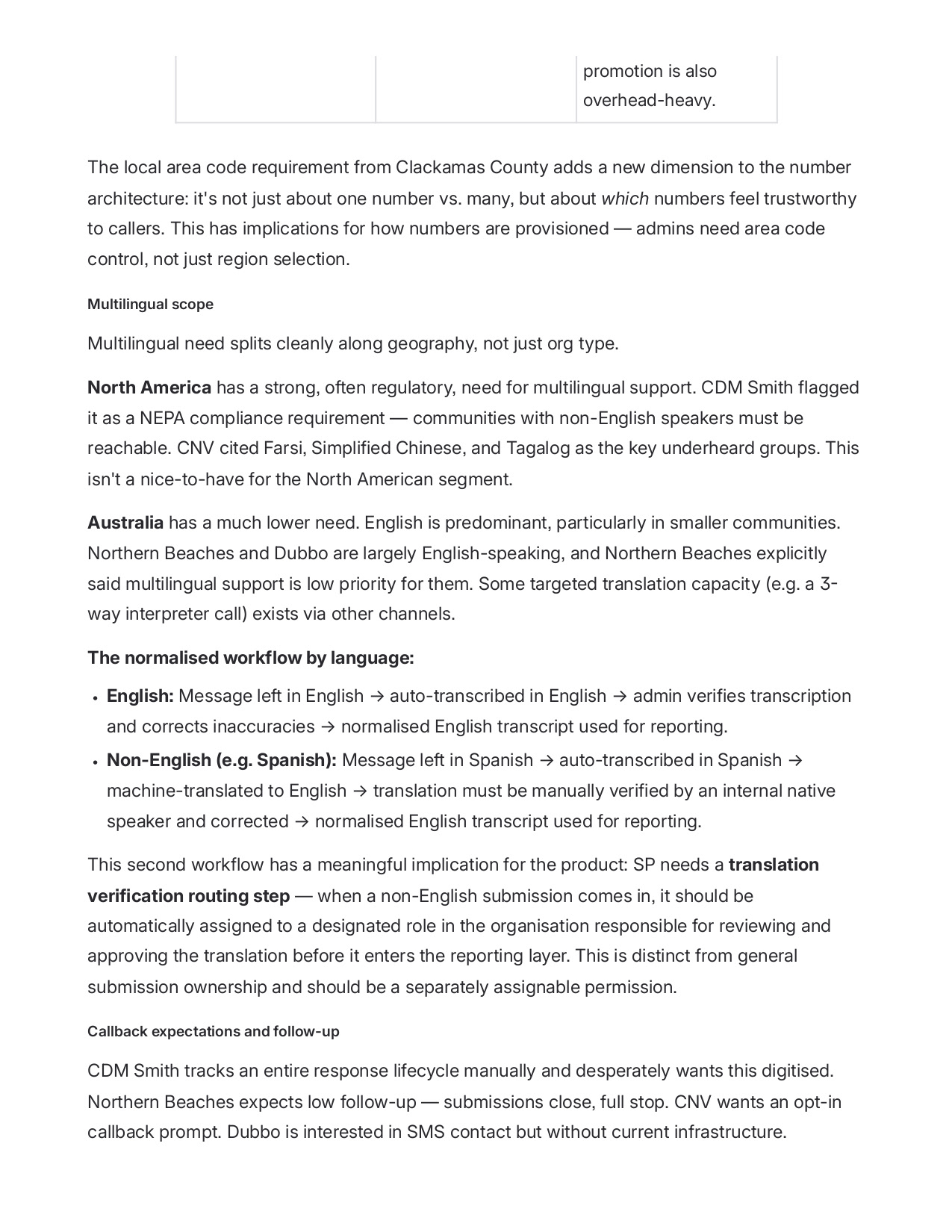
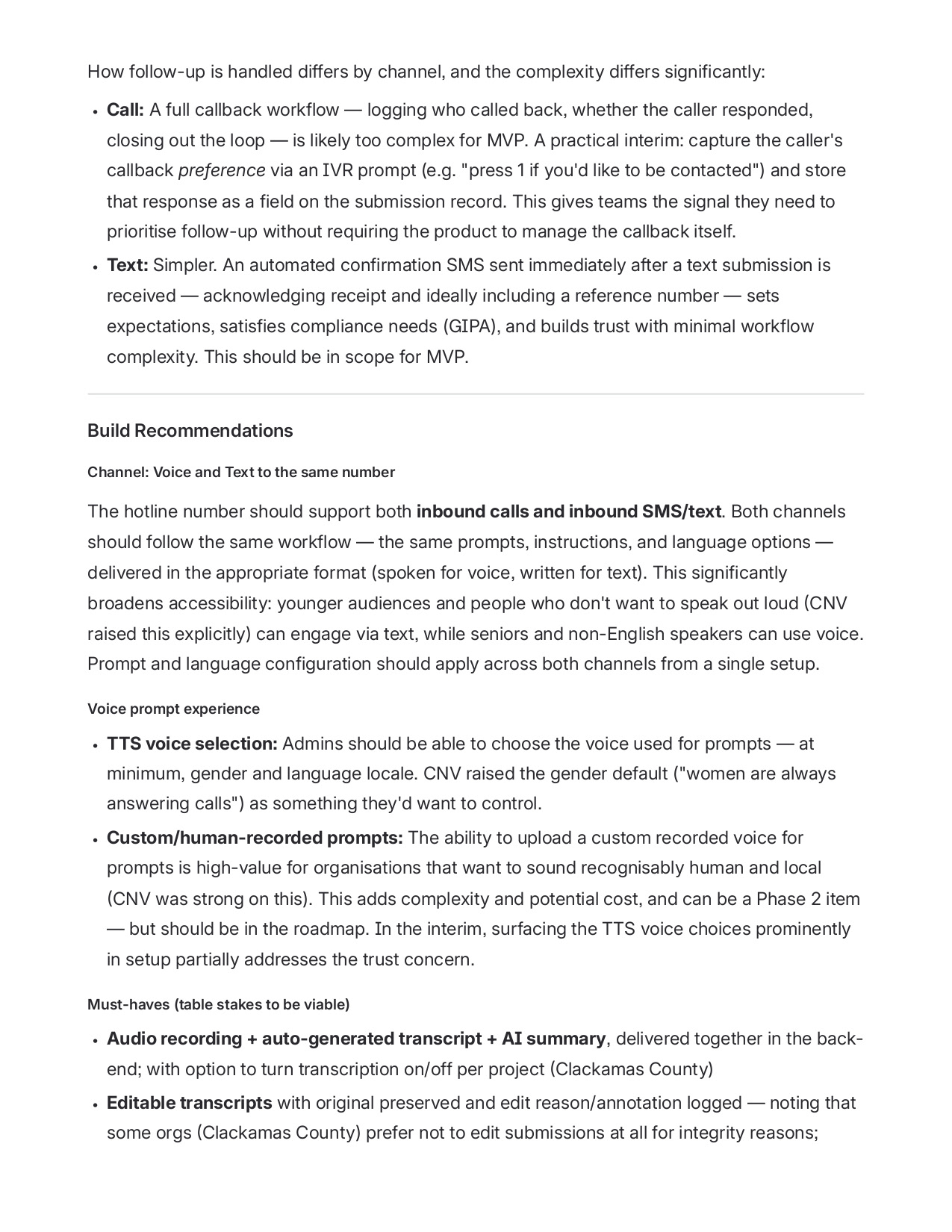
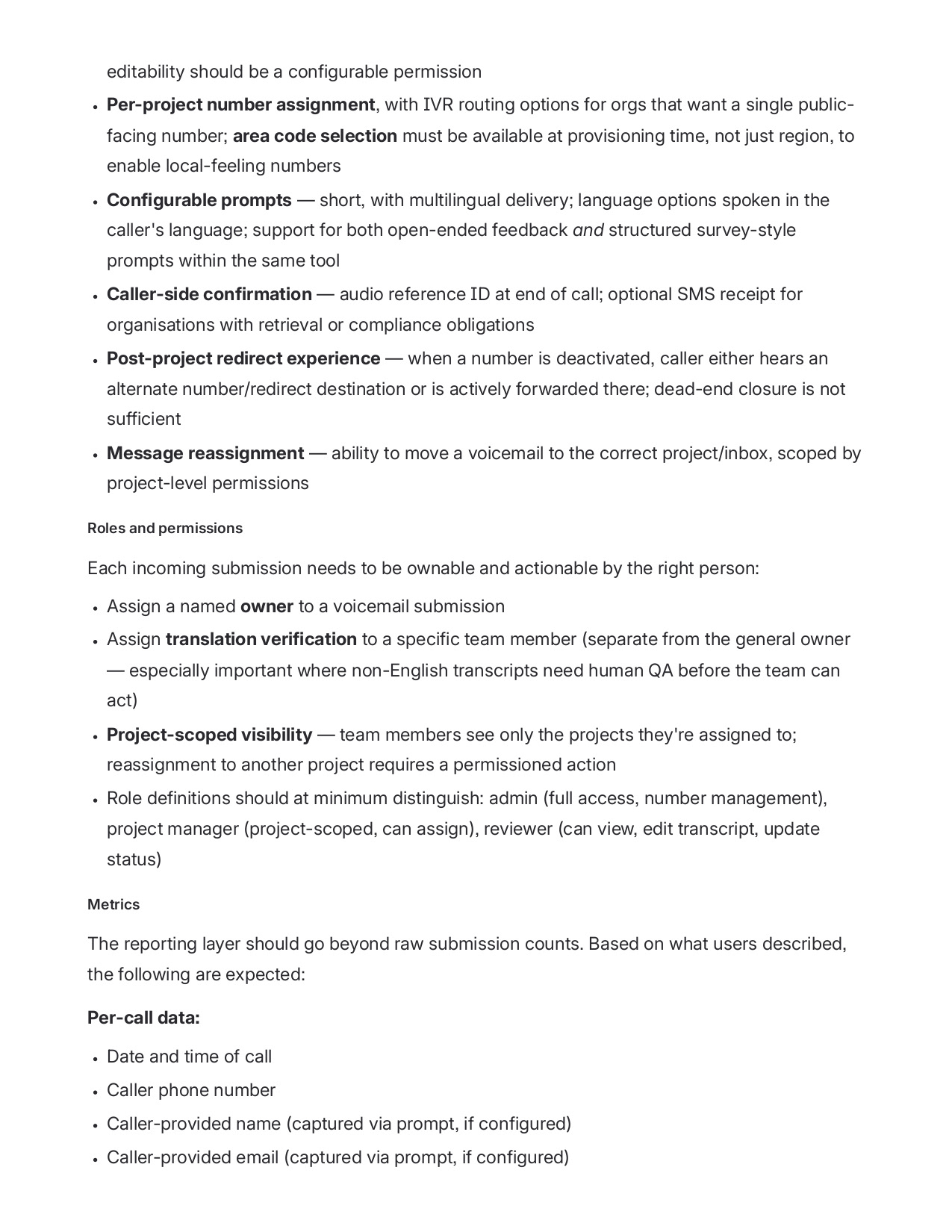
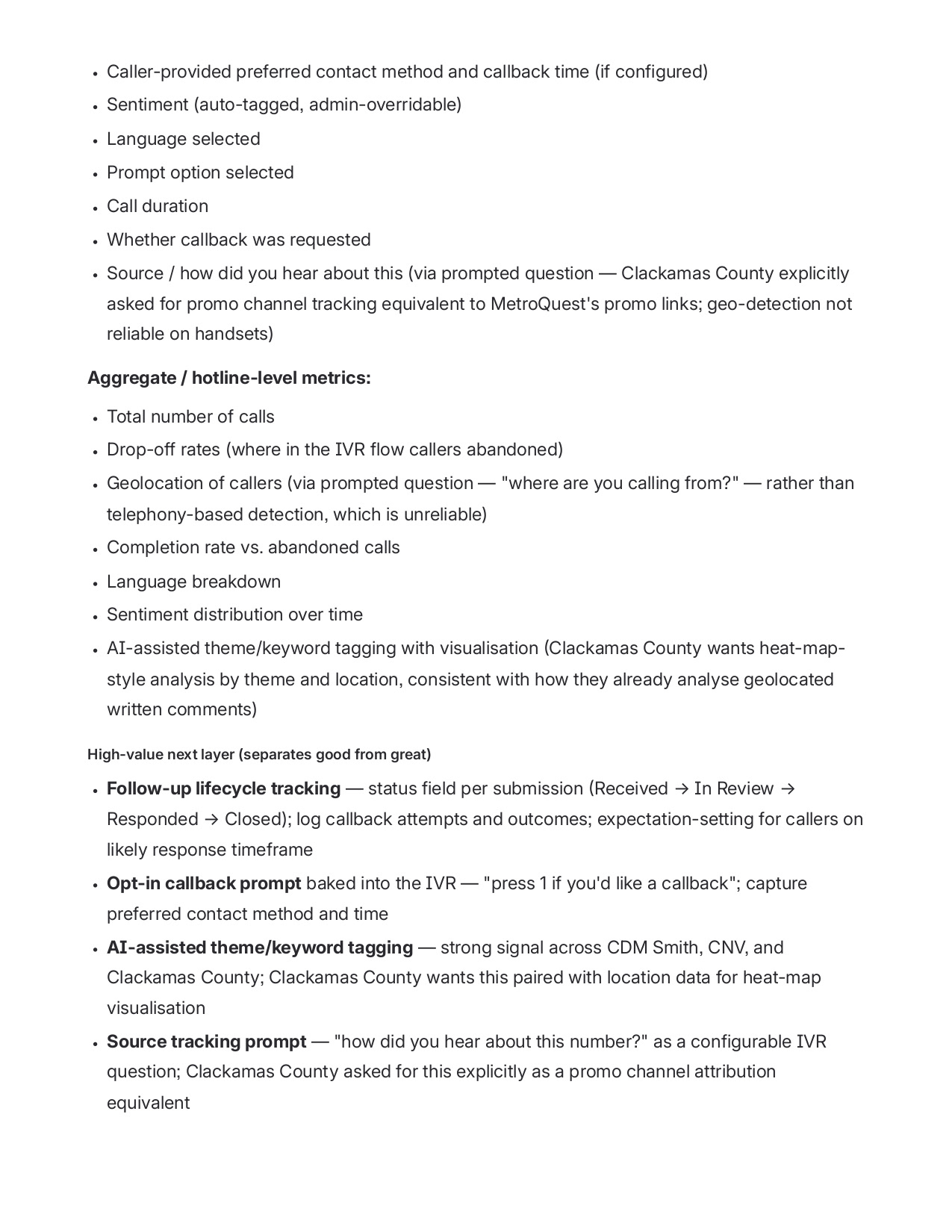
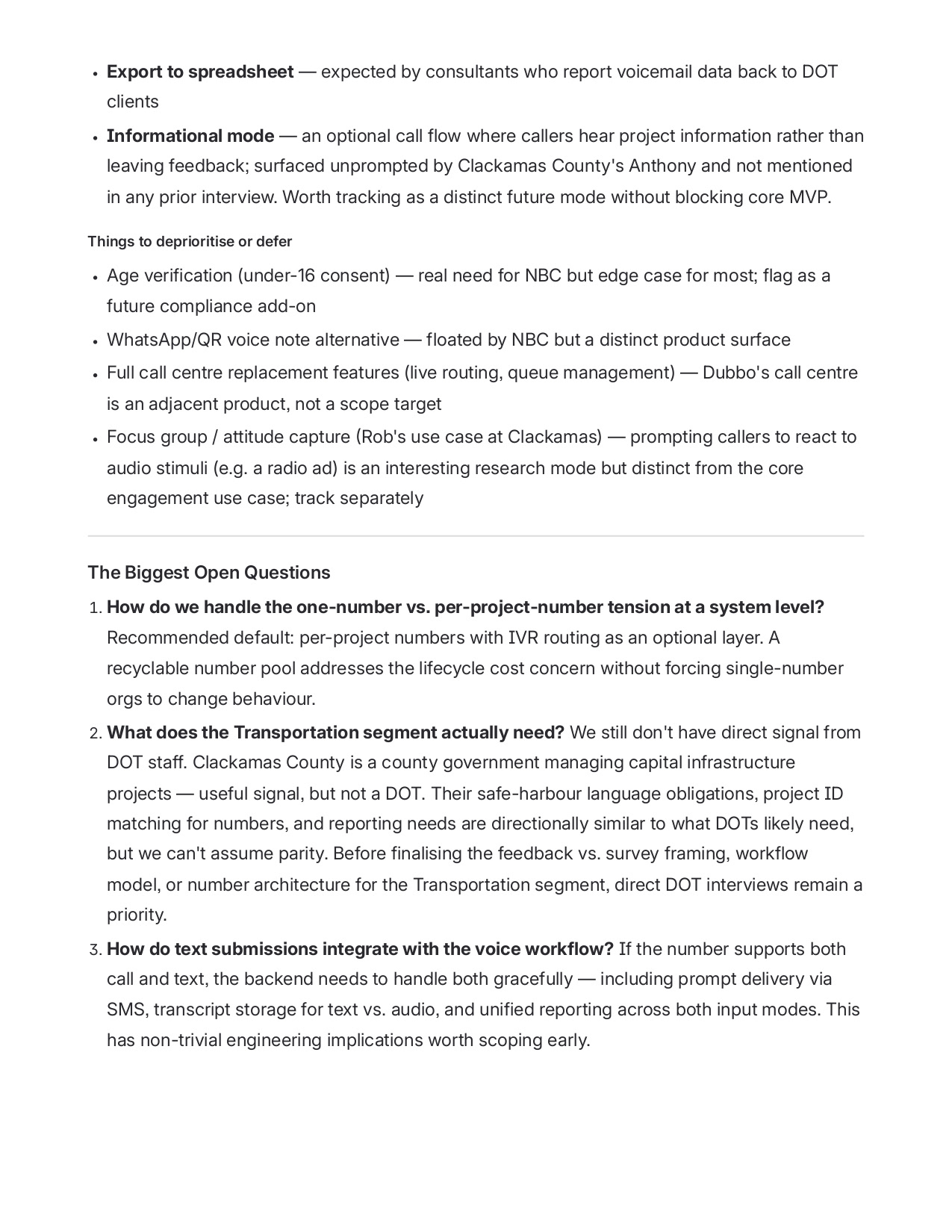
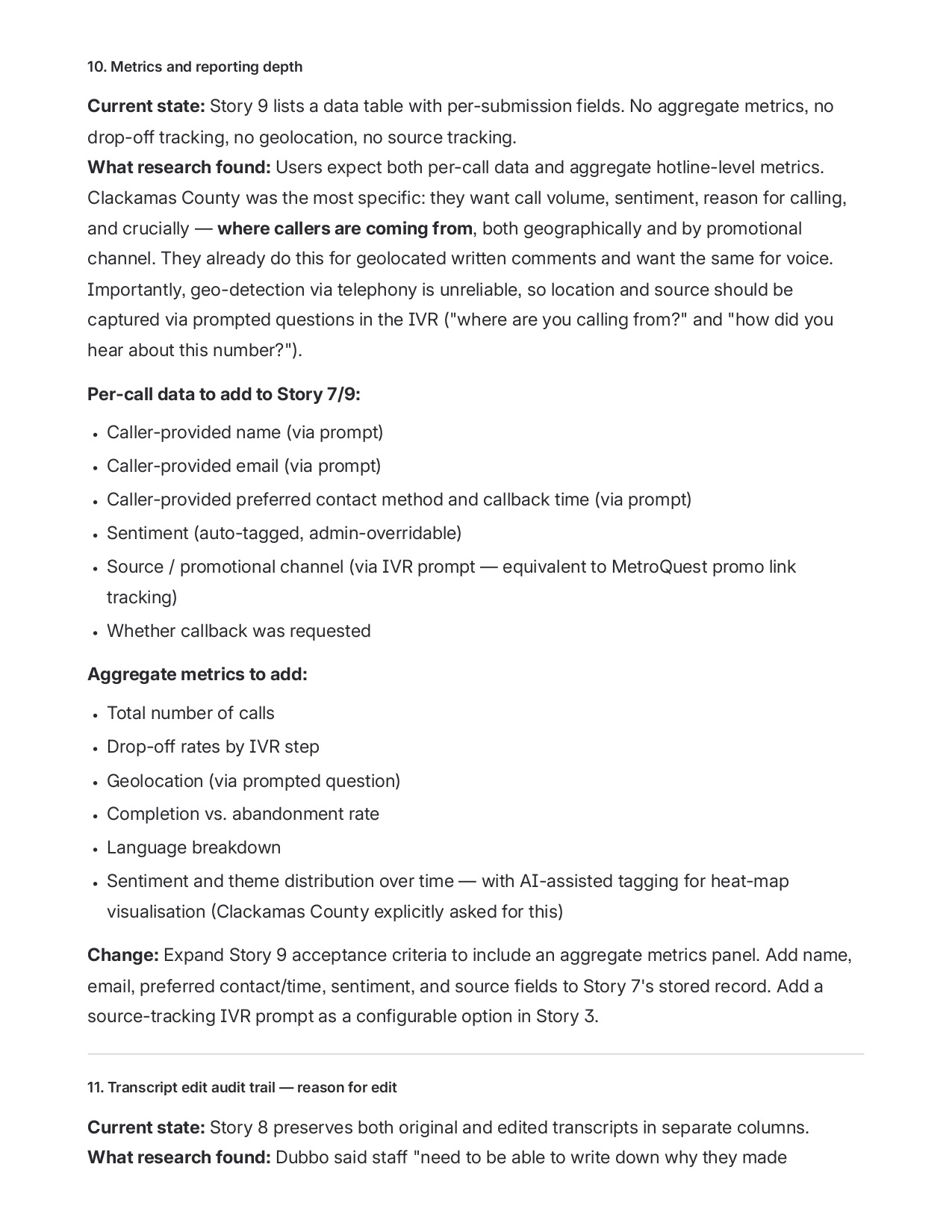
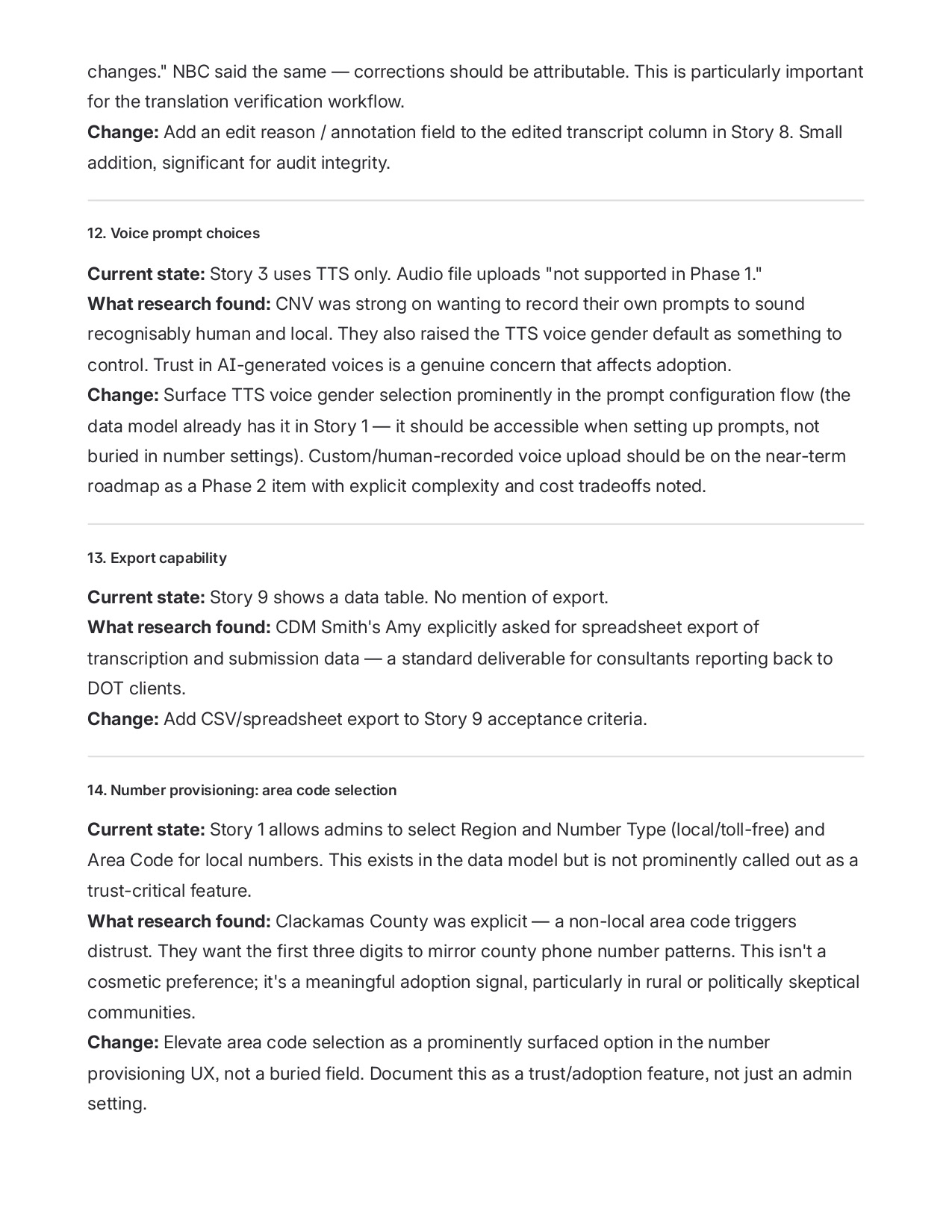
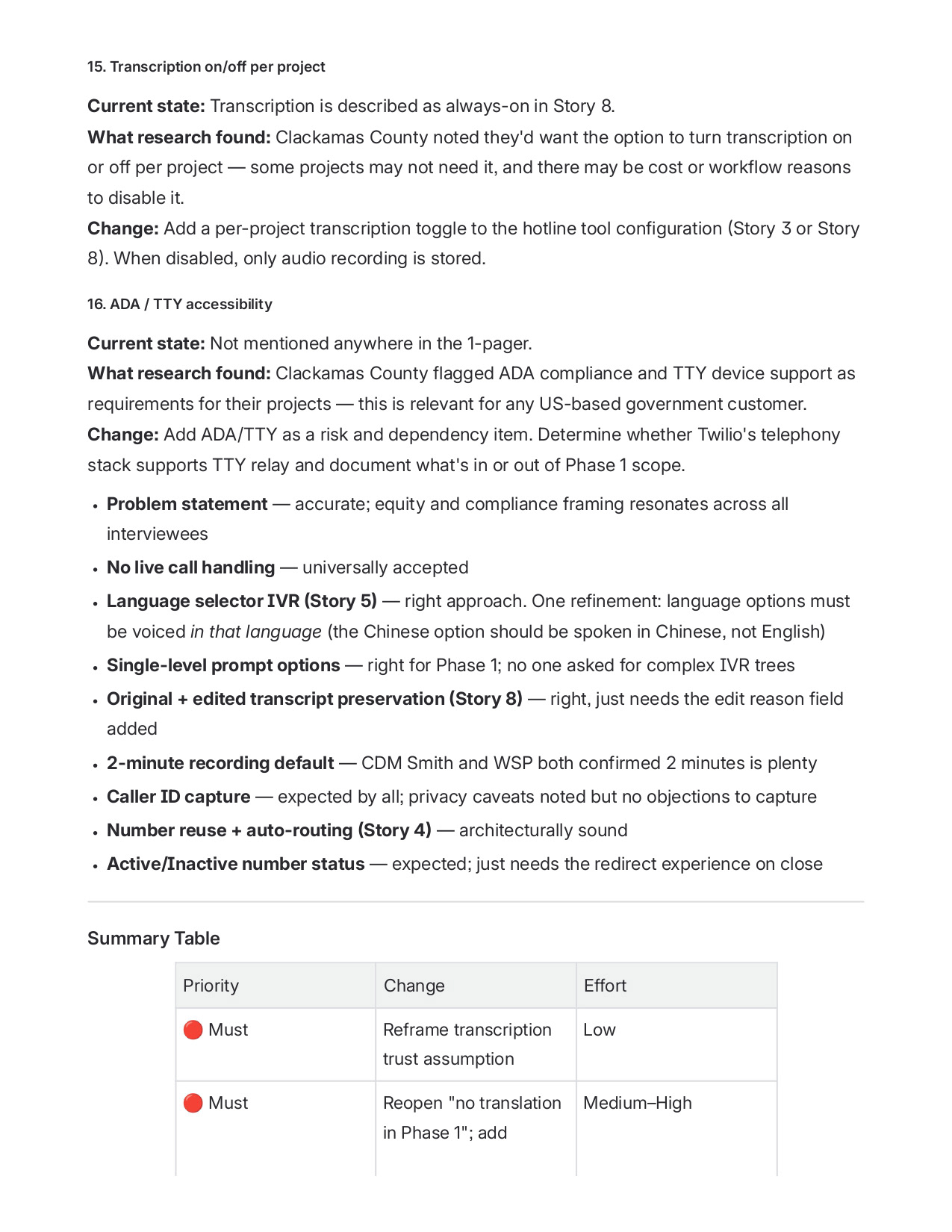
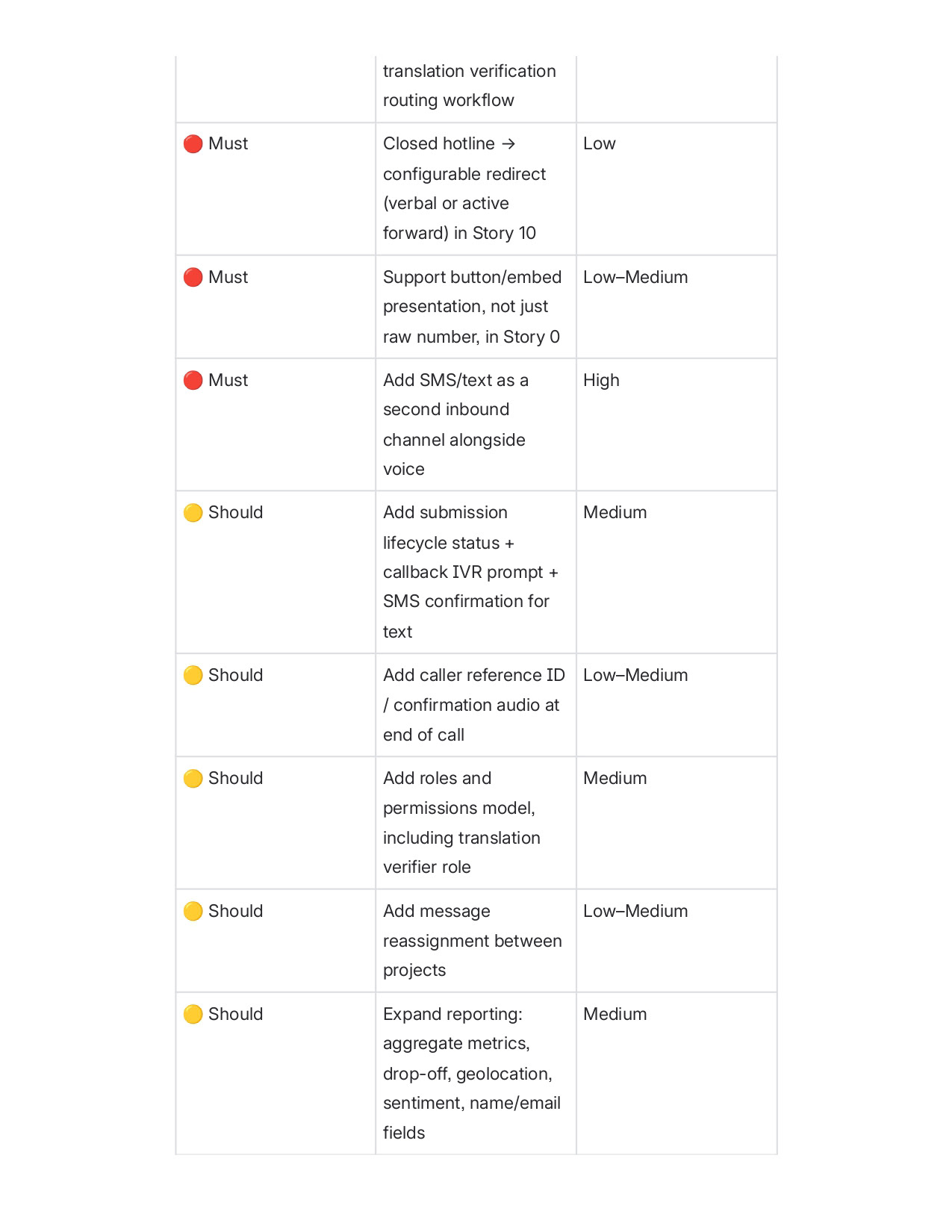
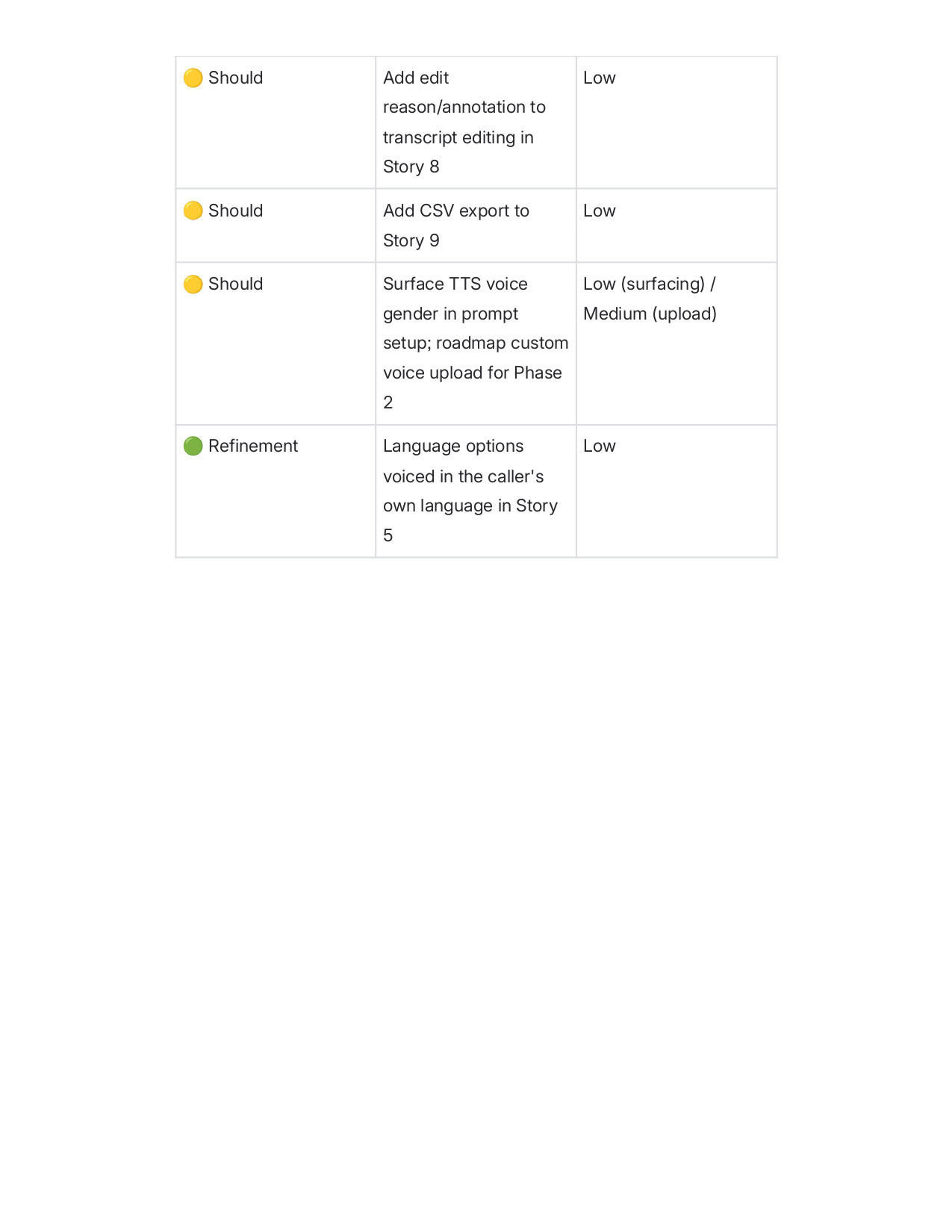
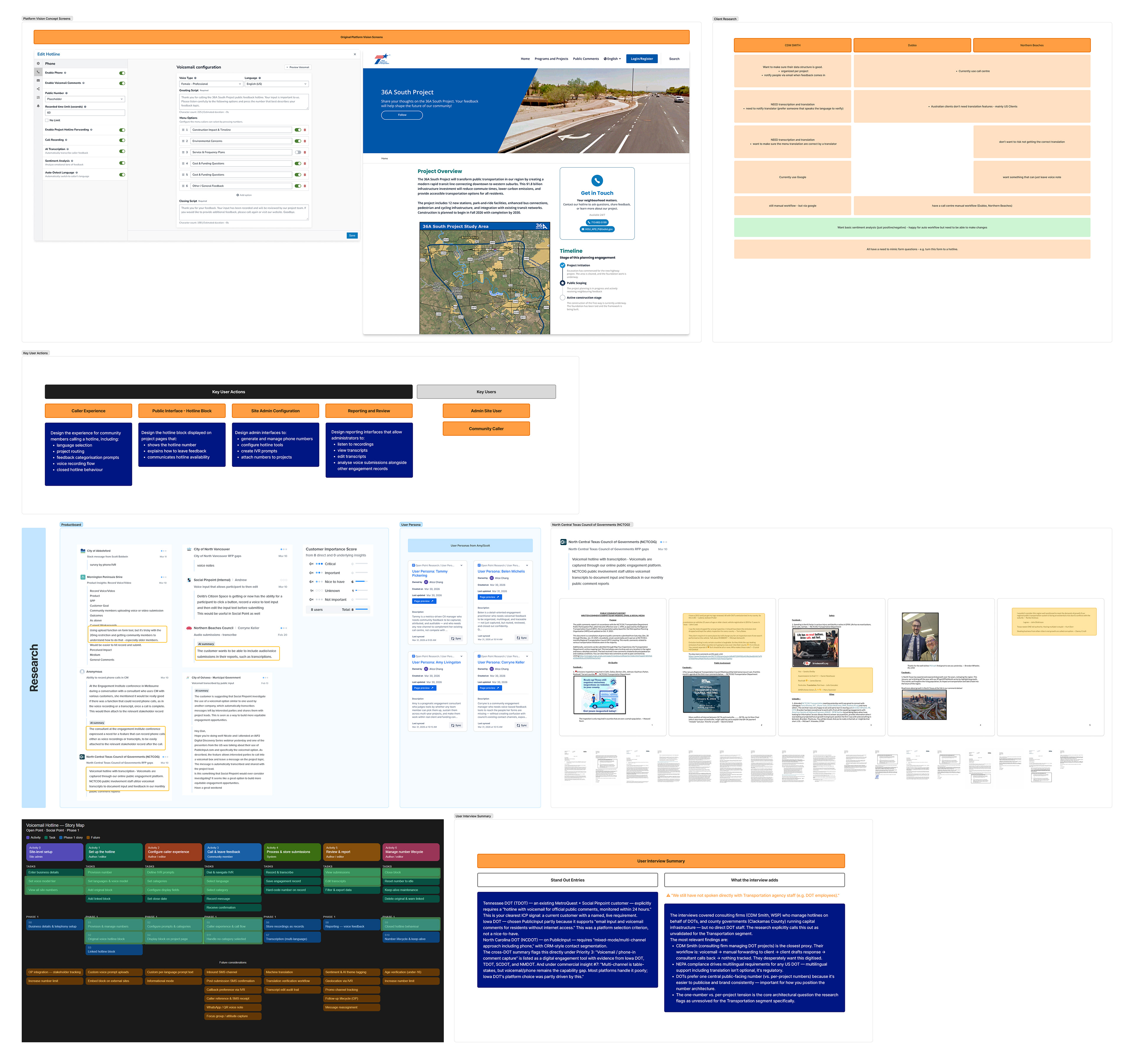
We ran interviews across consultants and local government teams managing public consultation hotlines to understand how voice feedback is currently handled. Across all orgs, voice emerged as a critical equity channel, but existing systems are fragmented — relying on voicemail, manual transcription, and disconnected workflows that make feedback hard to track, trust, and act on.
A consistent gap emerged between capturing voice input and operationalising it: teams struggle with ownership, multilingual handling, transcription reliability, and post-submission workflows like callbacks, reassignment, and reporting. While there is strong alignment on the need for audio + transcript together, editable transcripts with audit history, and structured reporting, there is significant variation in how organisations expect to manage scale, compliance, and lifecycle complexity.
This synthesis informed key product decisions around workflow ownership, translation verification, number architecture, and lifecycle management, ensuring the Voice Hotline system supports both accessibility requirements and real-world operational constraints across government and infrastructure contexts.
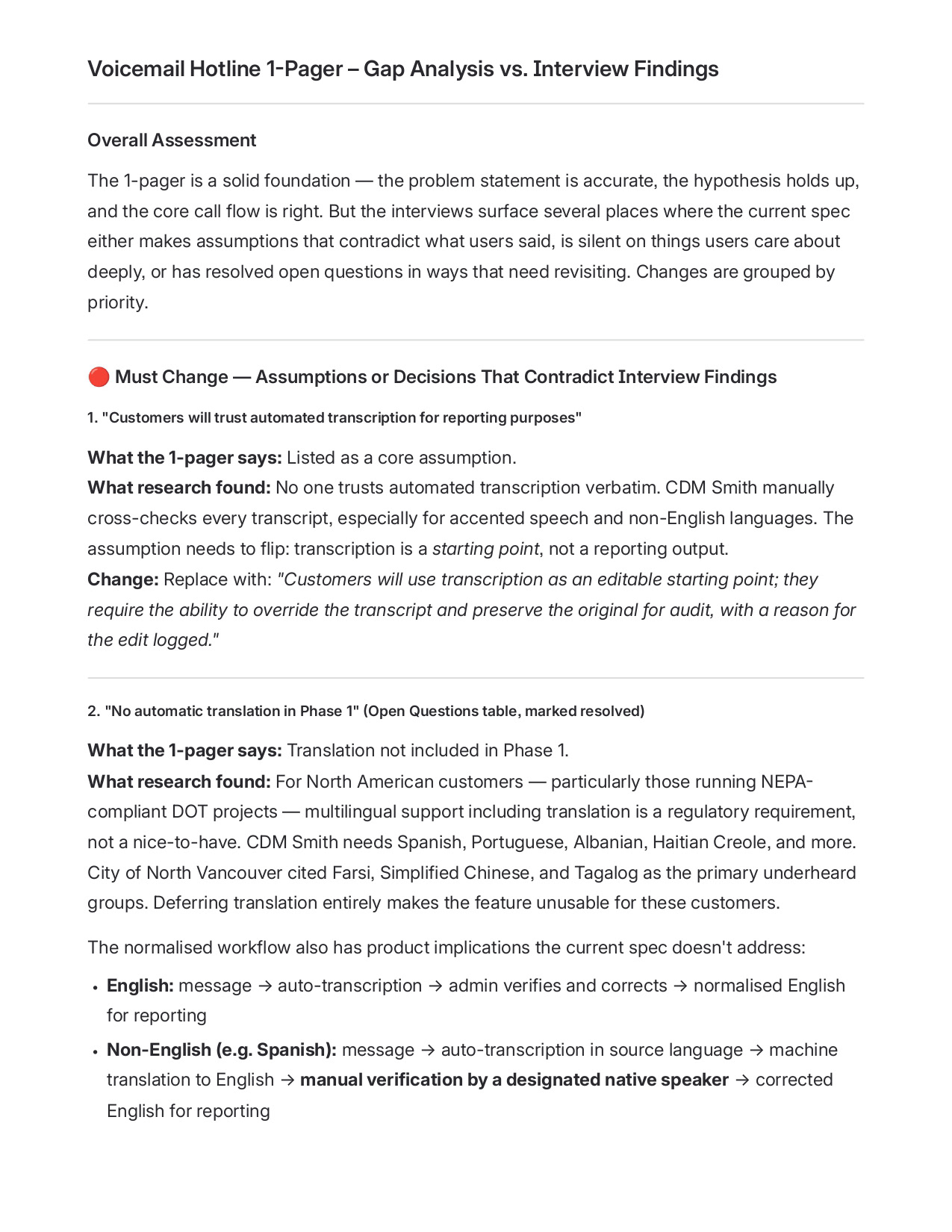
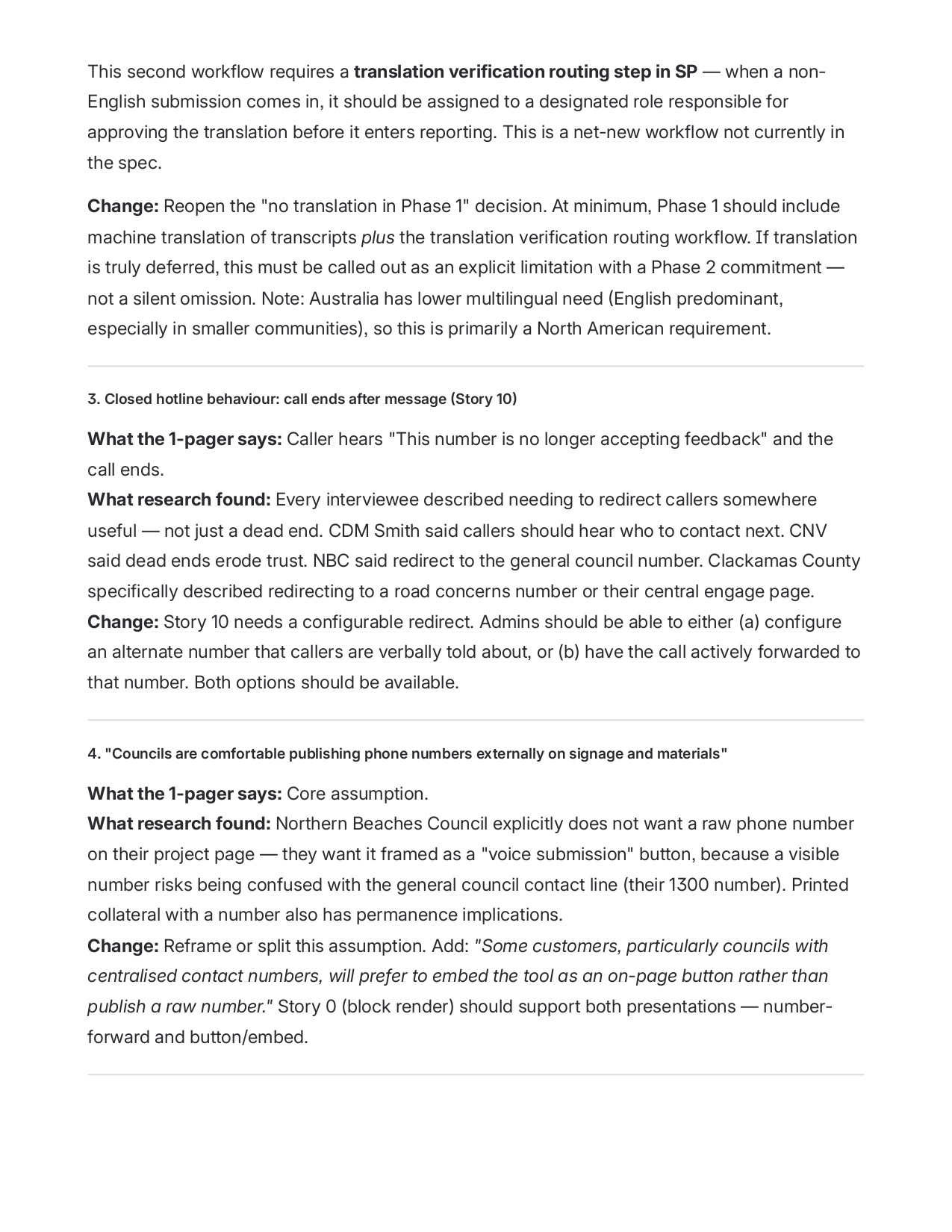
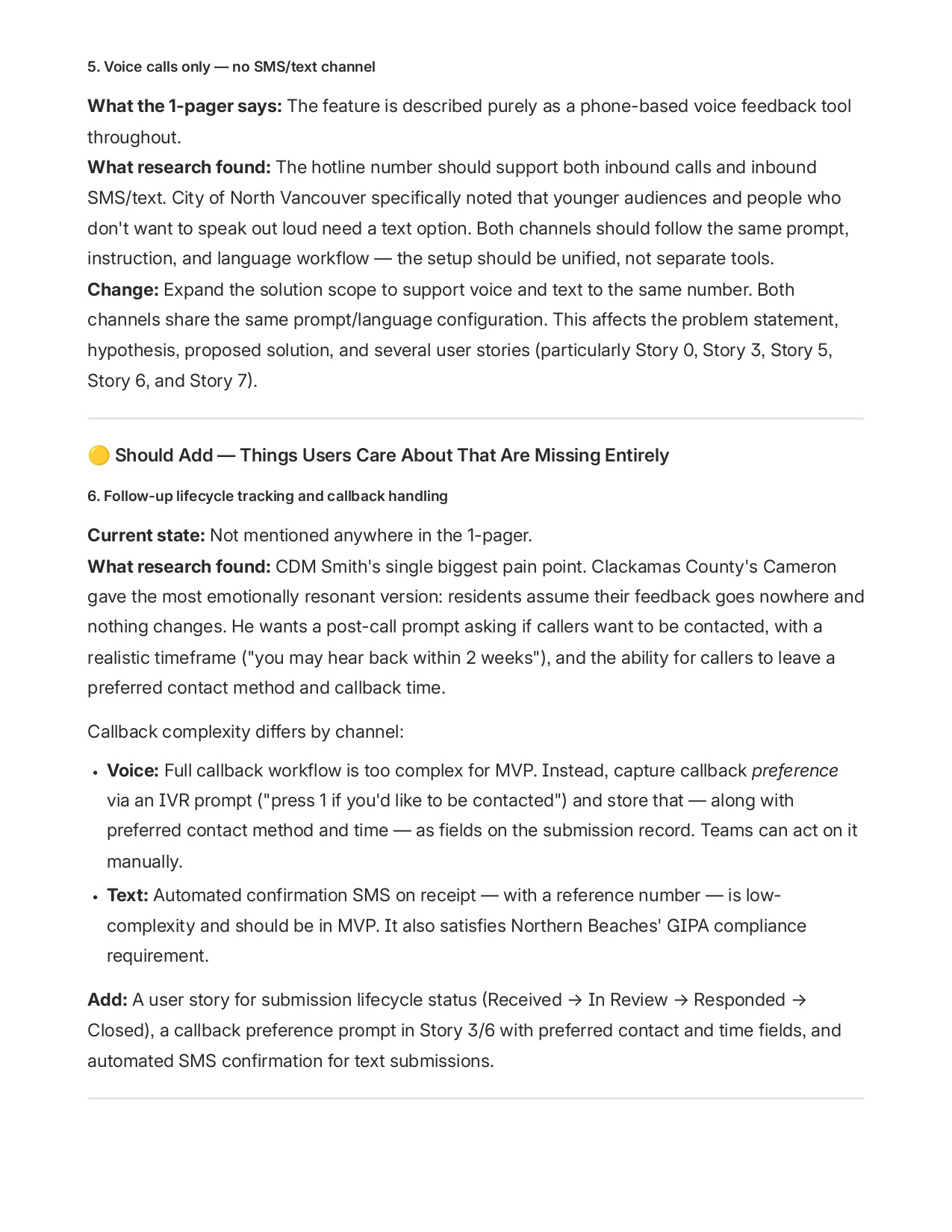
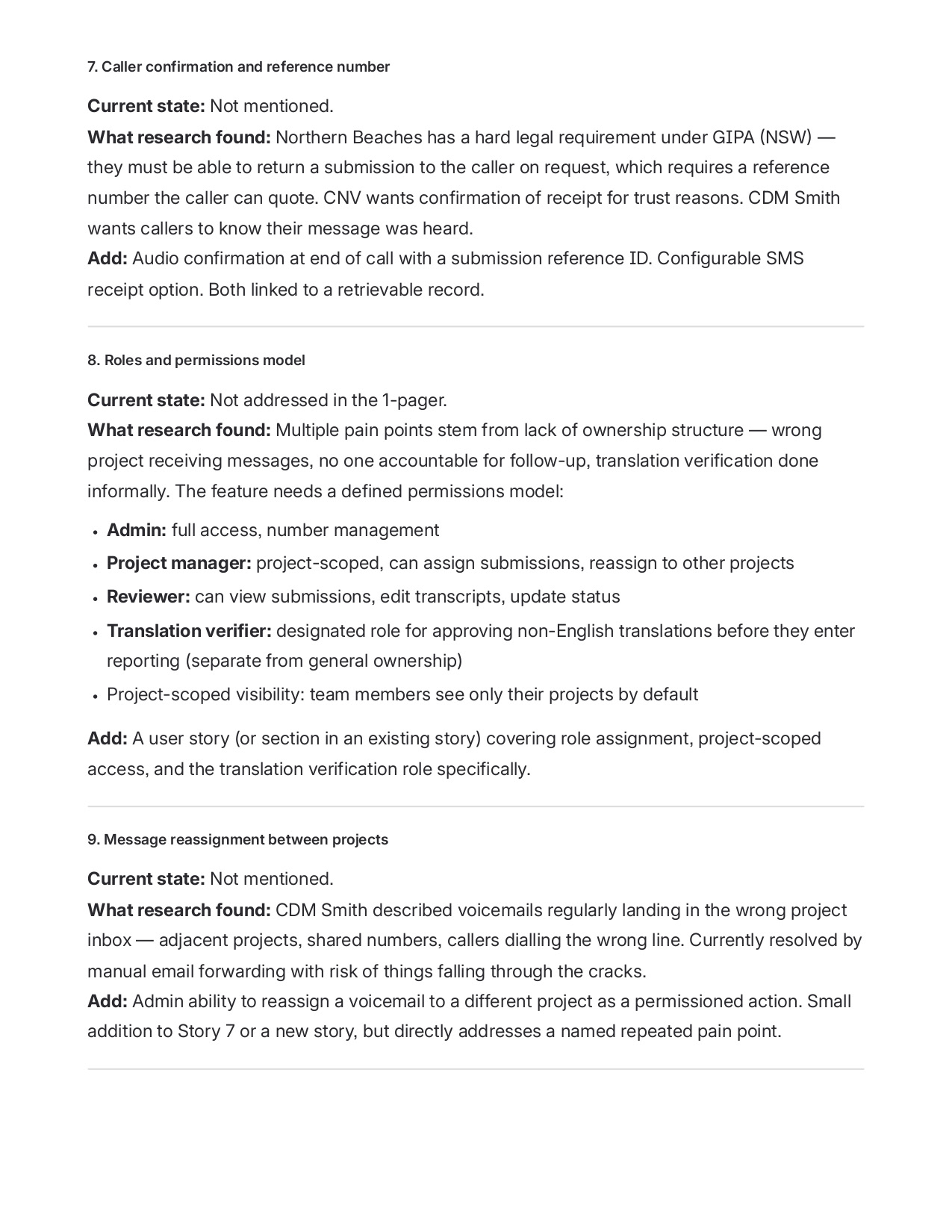
Key Insights → Design Principles
From the research, I defined several core principles that guided the system design:
Voice feedback is infrastructure, not a feature
It must behave like a governed data channel inside the platform, not an isolated tool.
It must behave like a governed data channel inside the platform, not an isolated tool.
Transcription is editable evidence, not truth
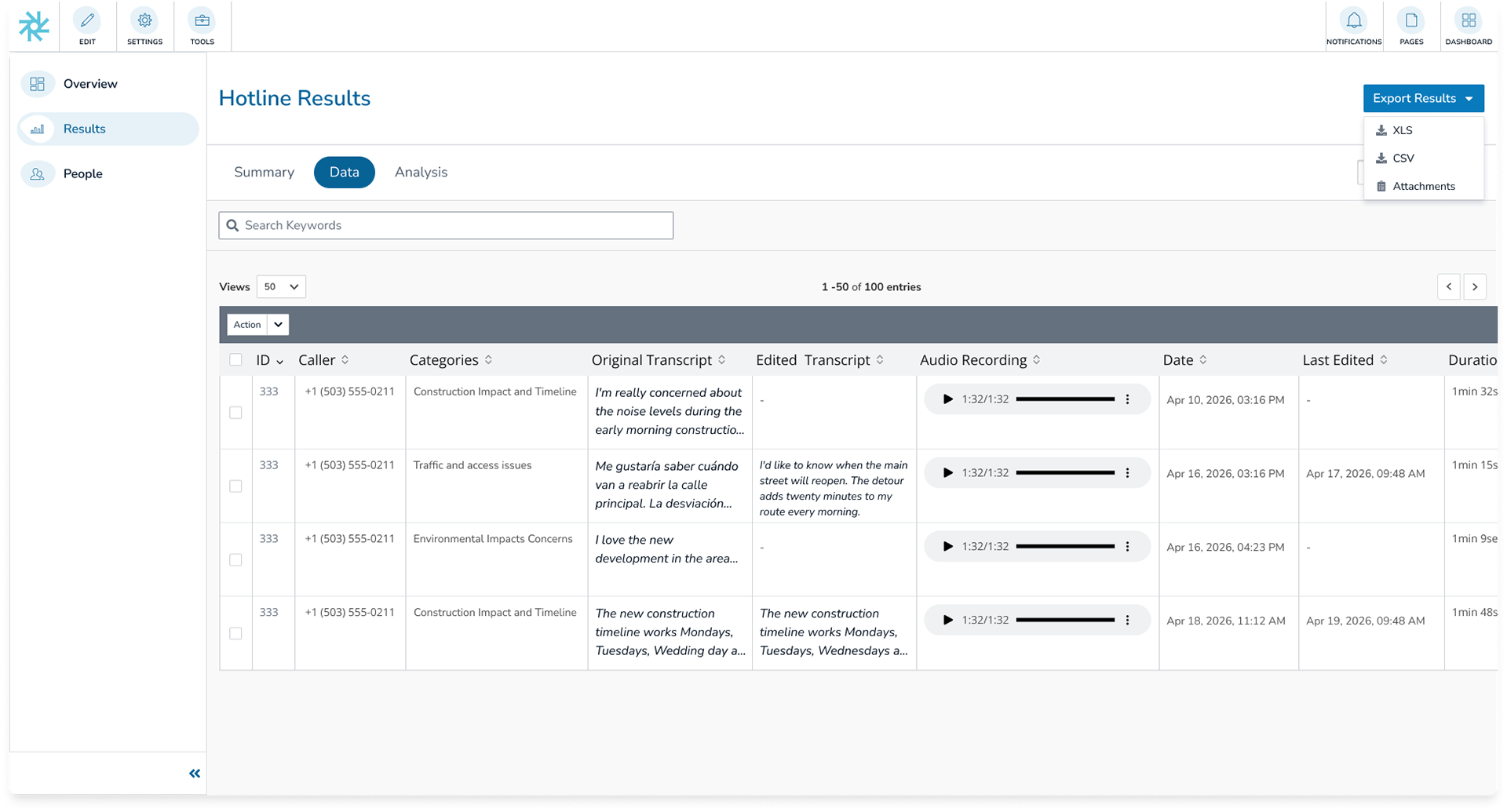
All transcripts must be editable, but original audio must always be preserved for audit integrity.
All transcripts must be editable, but original audio must always be preserved for audit integrity.
Ownership is a system problem, not a UI problem
Every submission needs clear ownership, routing, and reassignability across teams and projects.
Every submission needs clear ownership, routing, and reassignability across teams and projects.
Multilingual support is a workflow, not a toggle
Translation requires verification steps, not just automated output.
Translation requires verification steps, not just automated output.
Caller trust is part of the product experience
Confirmation, expectations, and closure messaging are essential to credibility.
Confirmation, expectations, and closure messaging are essential to credibility.
Problem Framing & UX Discovery
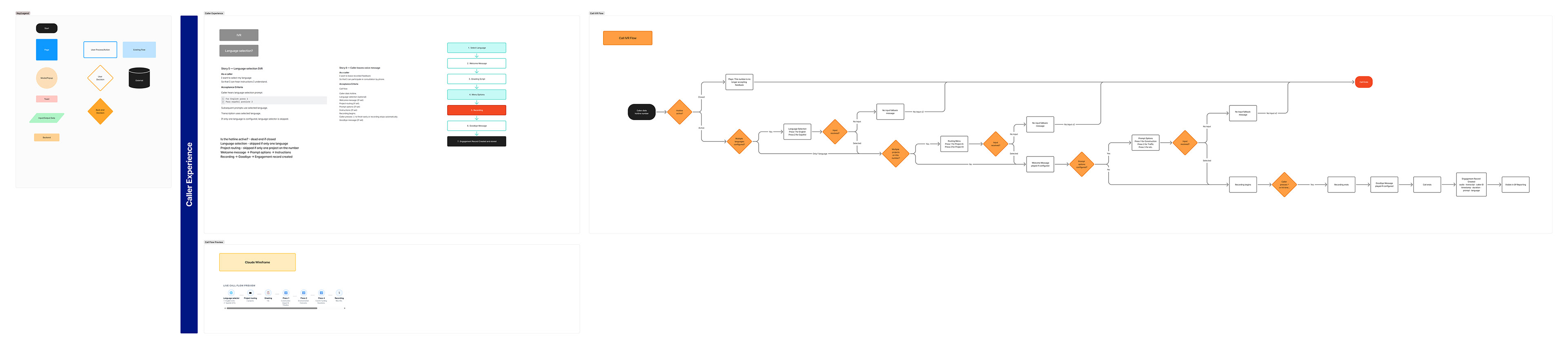
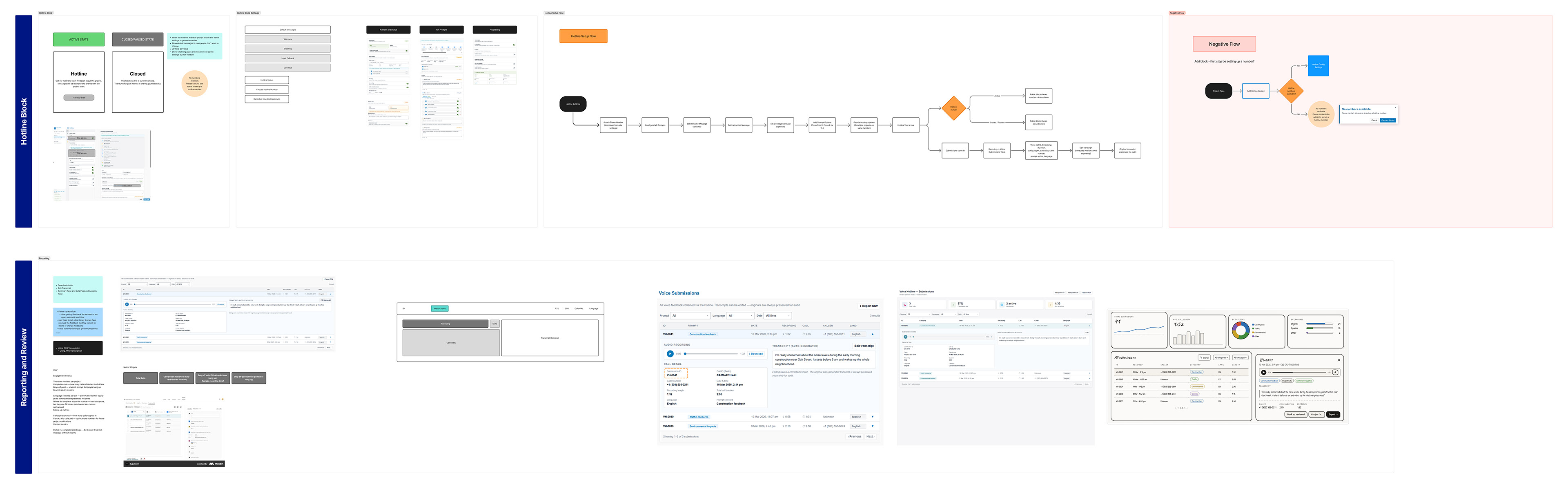
This is the early stage where I translated the PRD and initial product signals into a structured experience and system model. Using FigJam, I mapped out the end-to-end caller and admin journeys, identified key workflows, and broke the feature into logical building blocks such as IVR flows, hotline configuration, submission handling, and lifecycle states. This phase was less about visual design and more about defining how the system should behave under different conditions, including edge cases like multilingual routing, closed projects, and message ownership. It helped surface dependencies early, clarify the core product structure, and align stakeholders on what needed to exist before moving into high-fidelity design or AI-assisted exploration.

AI as a Design Collaborator
I used Claude as a system design thinking partner throughout this project, not as a UI generation tool, but as a way to explore complexity, test assumptions, and pressure-check edge cases early in the process.
Rather than moving linearly from research to design, I used AI to simulate system behaviour under different conditions — including multilingual routing, IVR decision trees, transcription rules, and lifecycle states.
Through structured prompting, I explored scenarios such as what happens when no input is provided in IVR flows, how translation verification should be assigned and validated, how linked hotlines inherit behaviour from an original configuration, and where ownership and reassignment logic breaks at scale.
This helped surface contradictions earlier in the process and refine system logic before committing to design. AI acted as a cognitive layer for system design, helping me move faster through ambiguity and focus on behavioural structure, governance, and edge-case resilience rather than surface-level execution.
System Exploration (AI Wireframes, Flows, High-Fidelity Iterations)
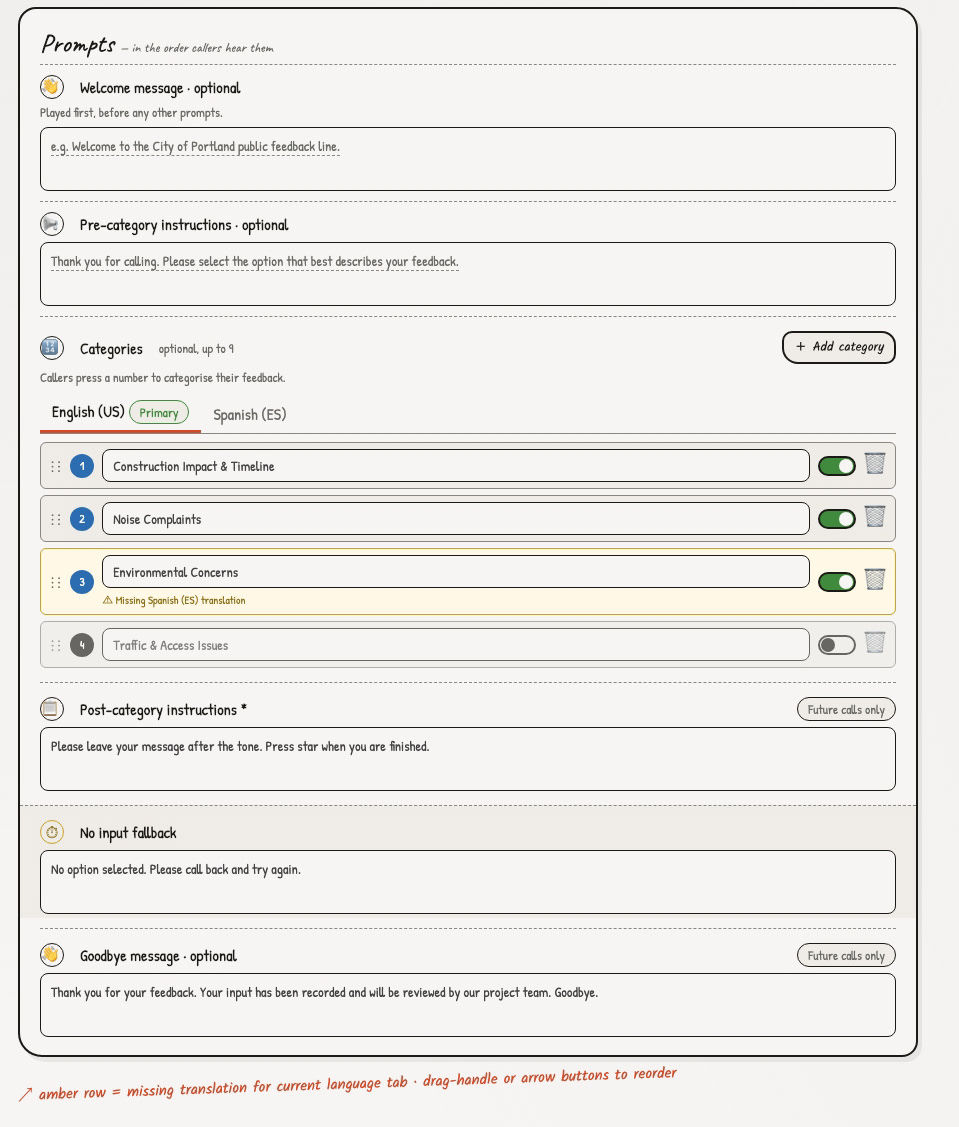
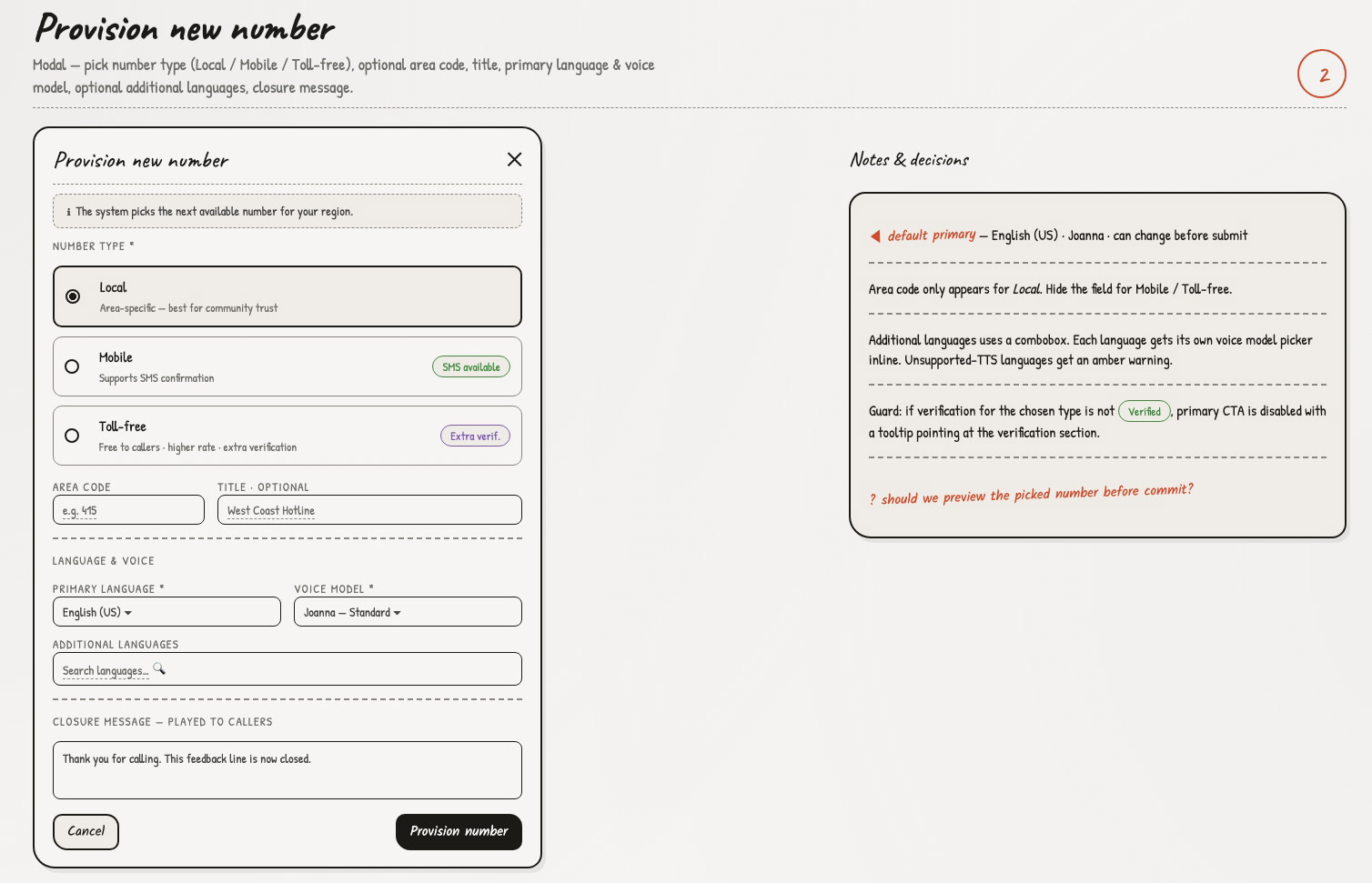
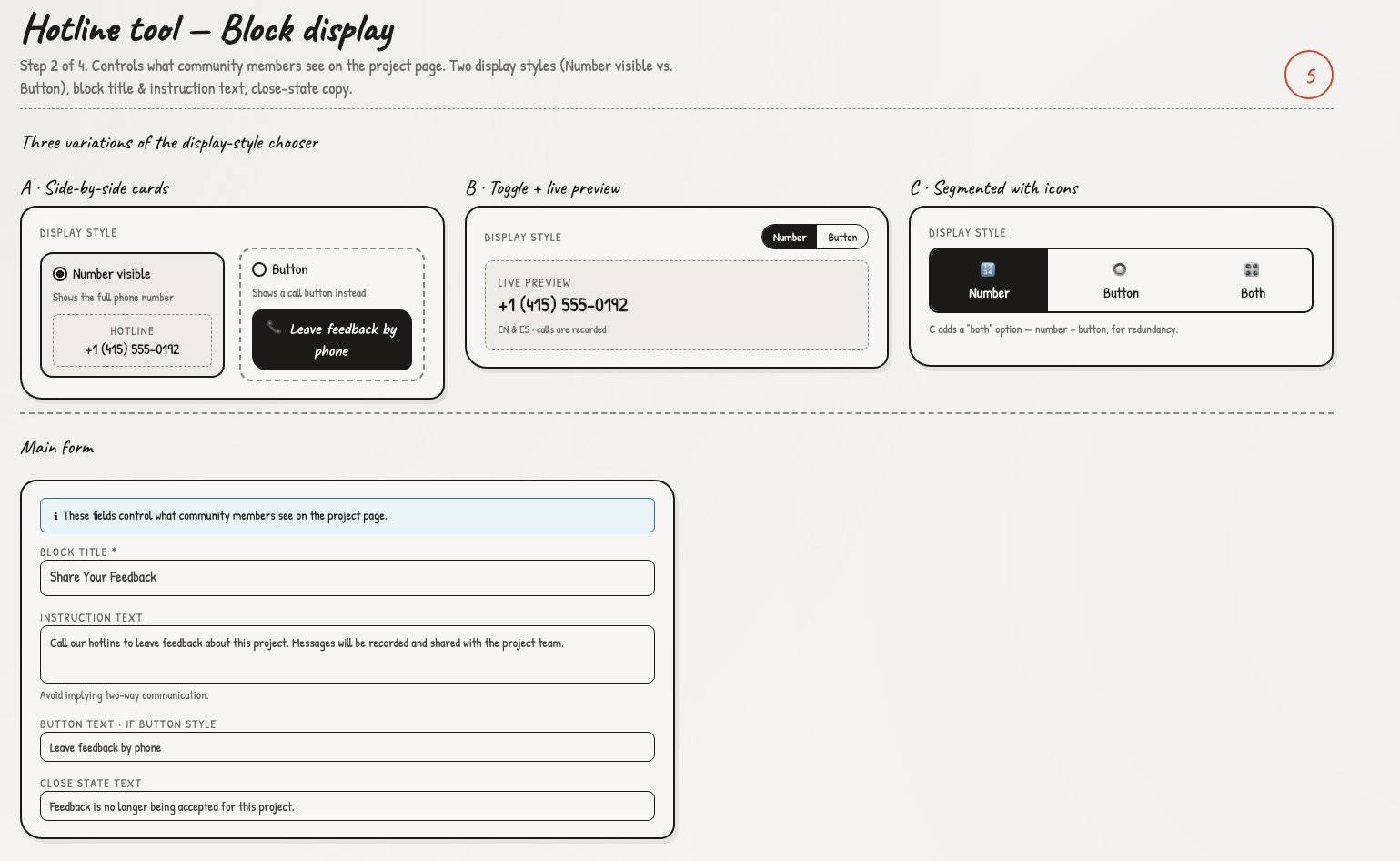
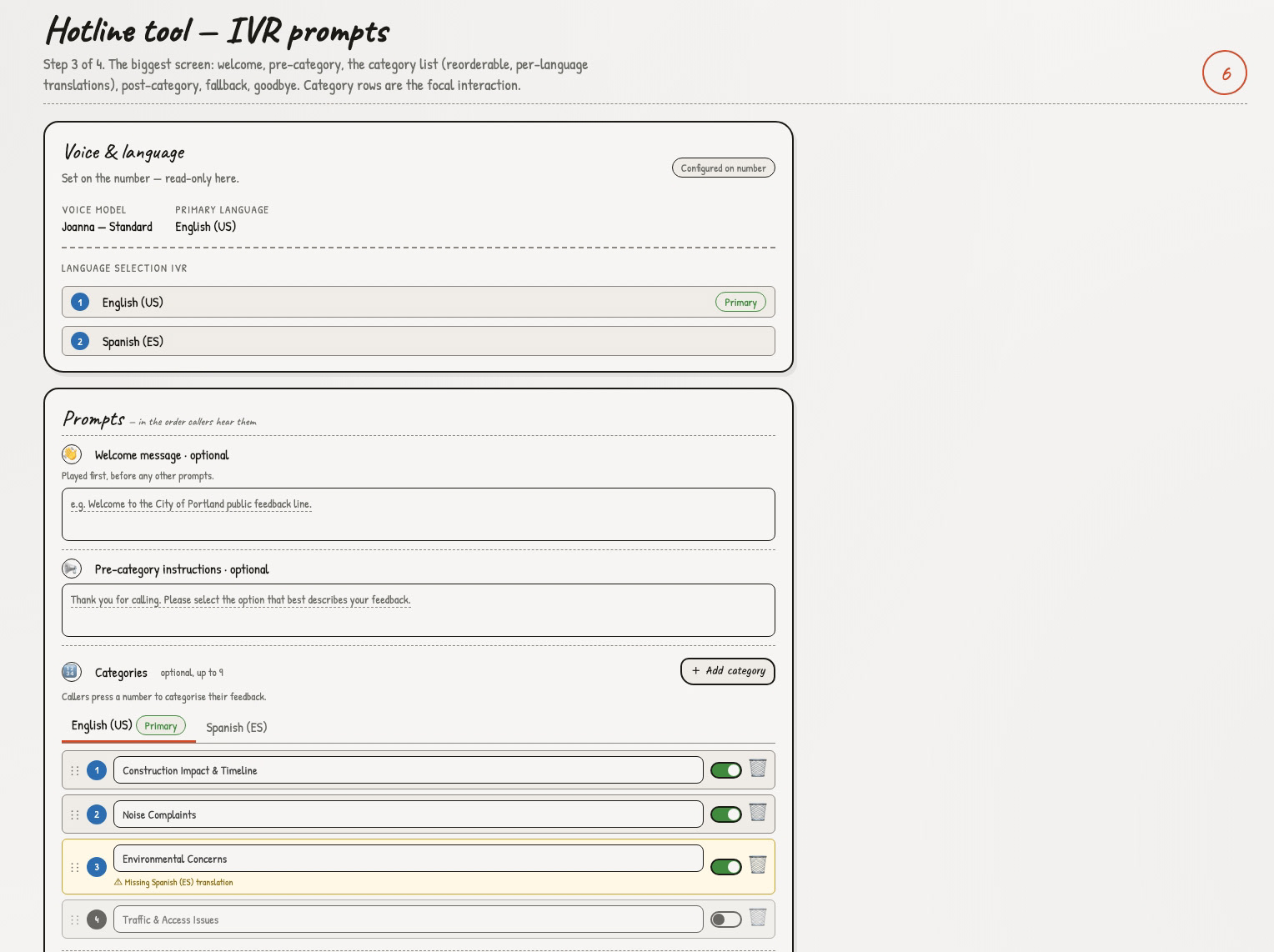
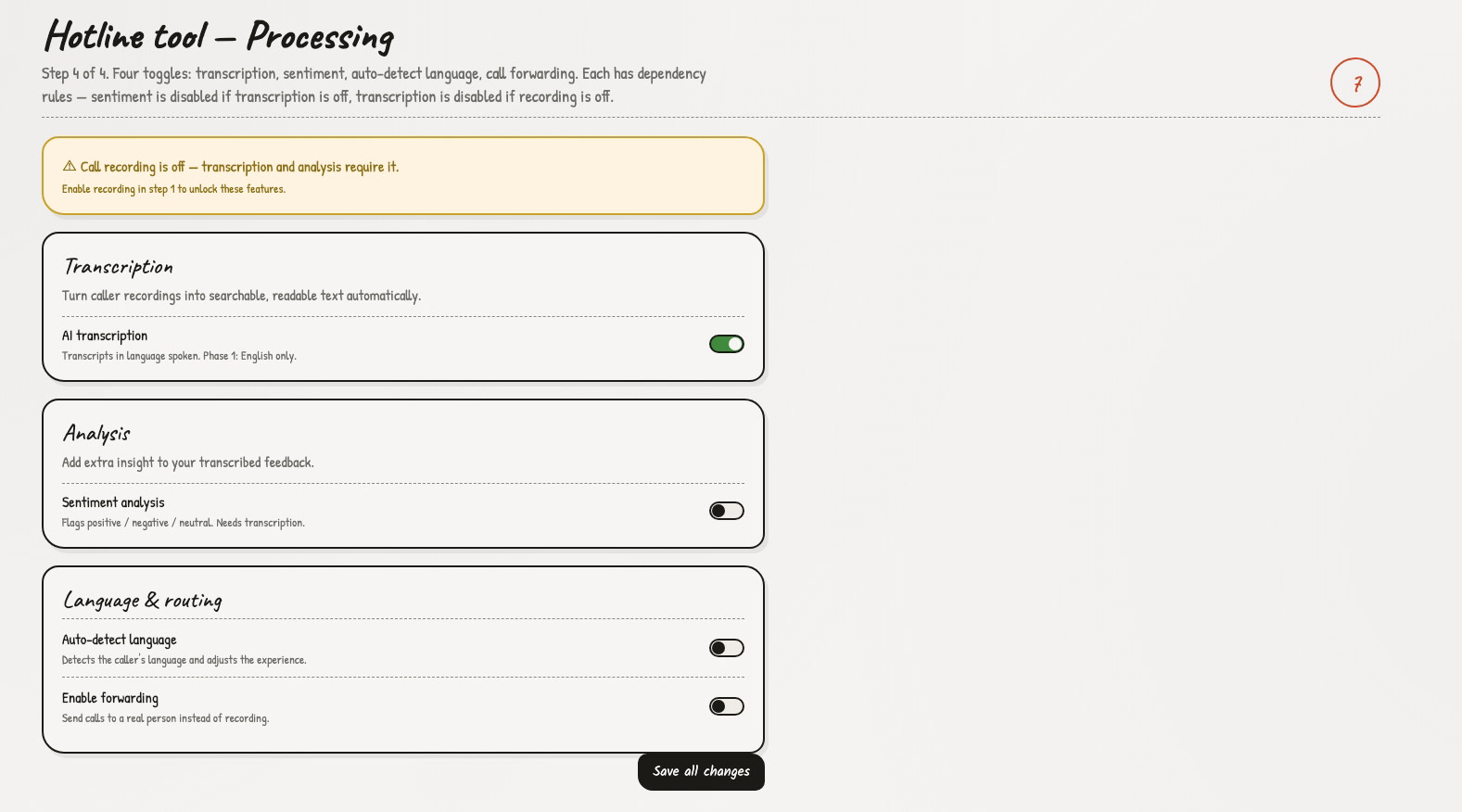
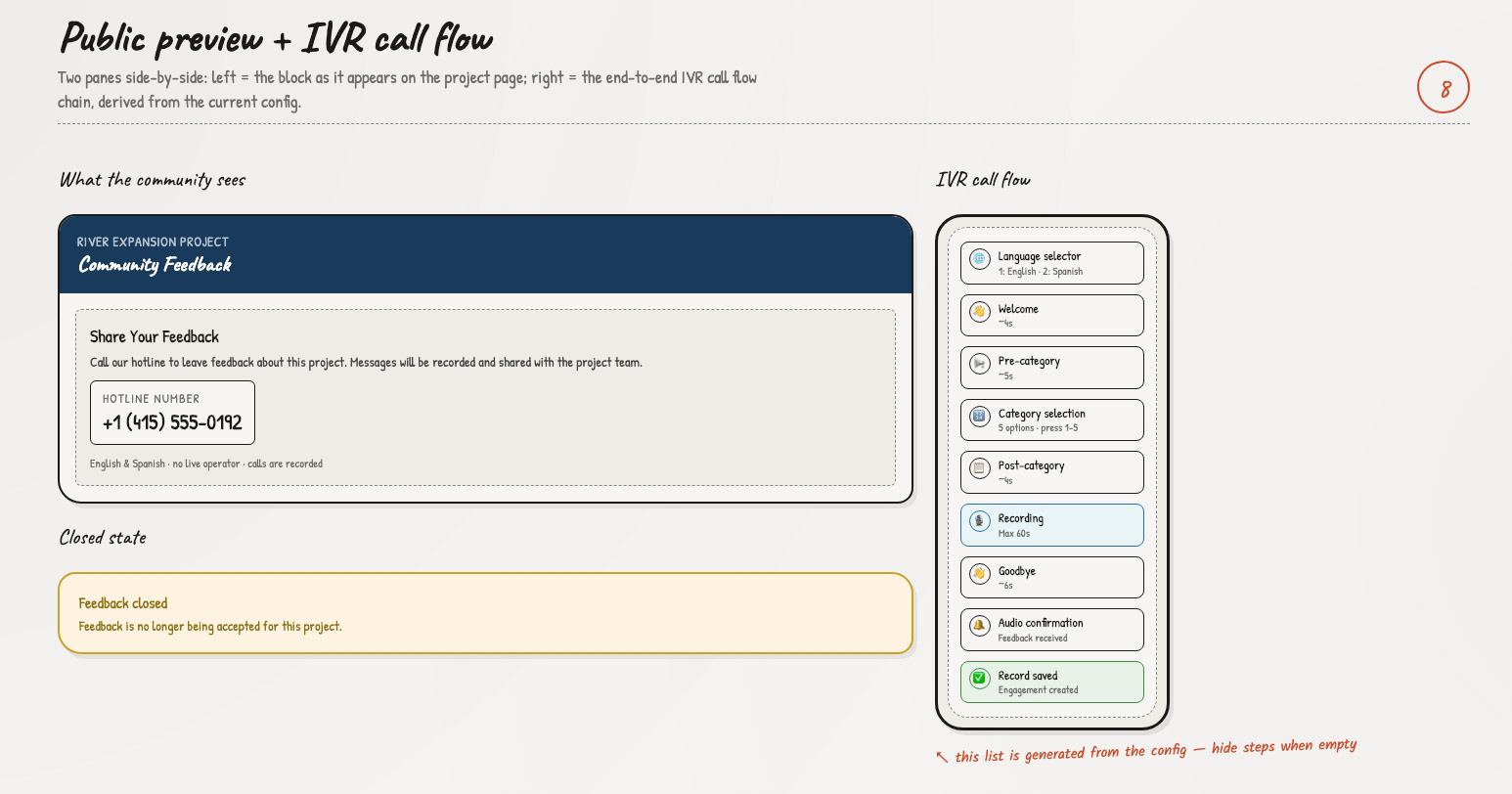
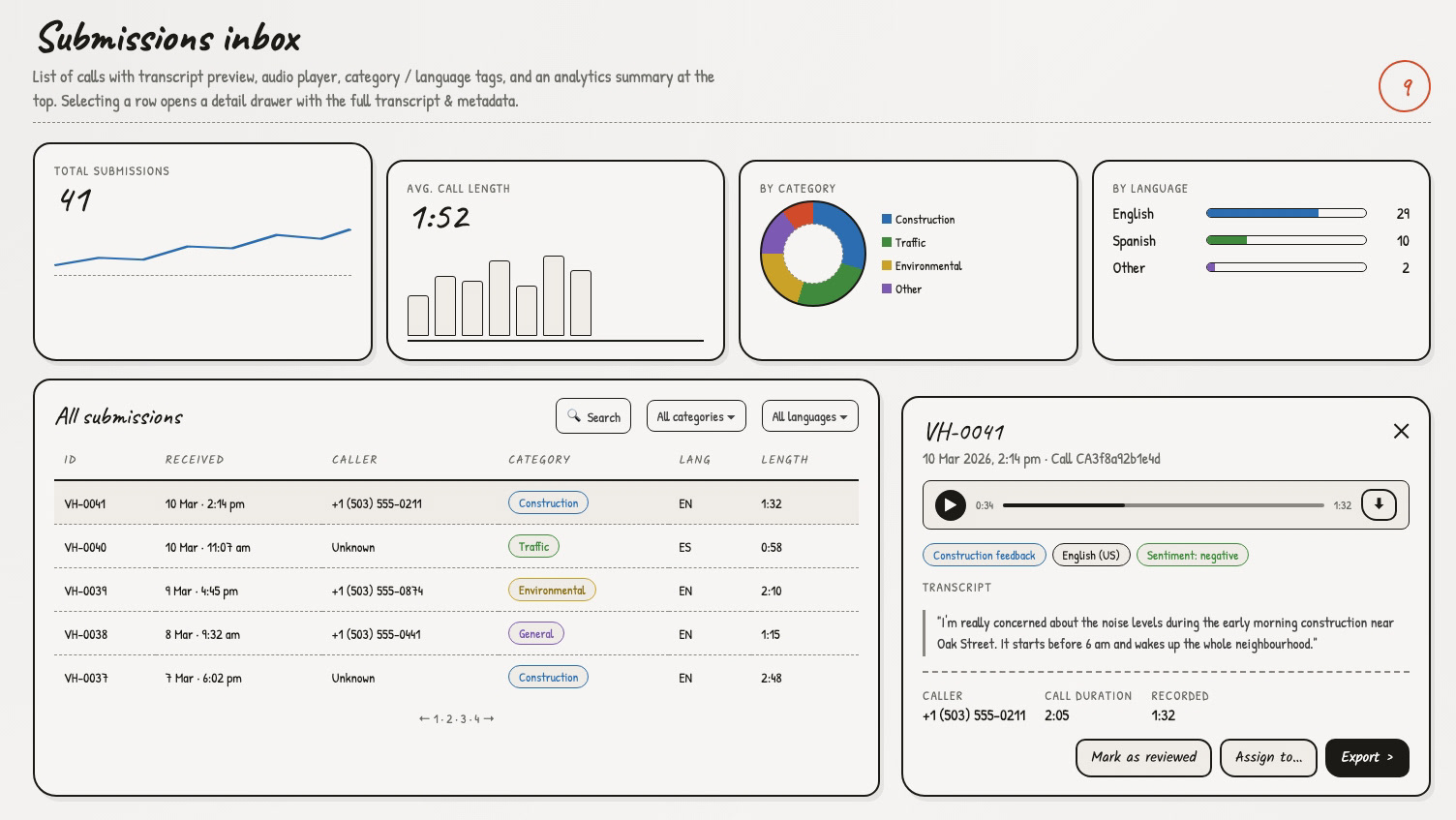
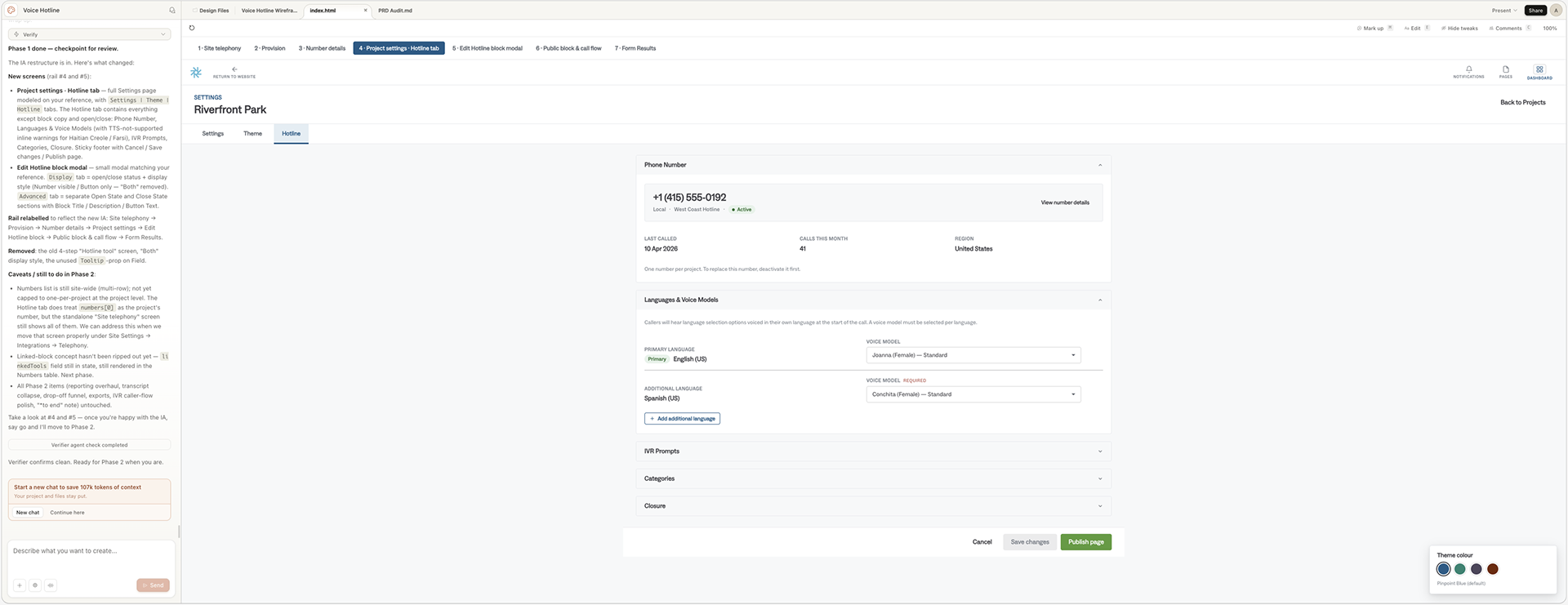
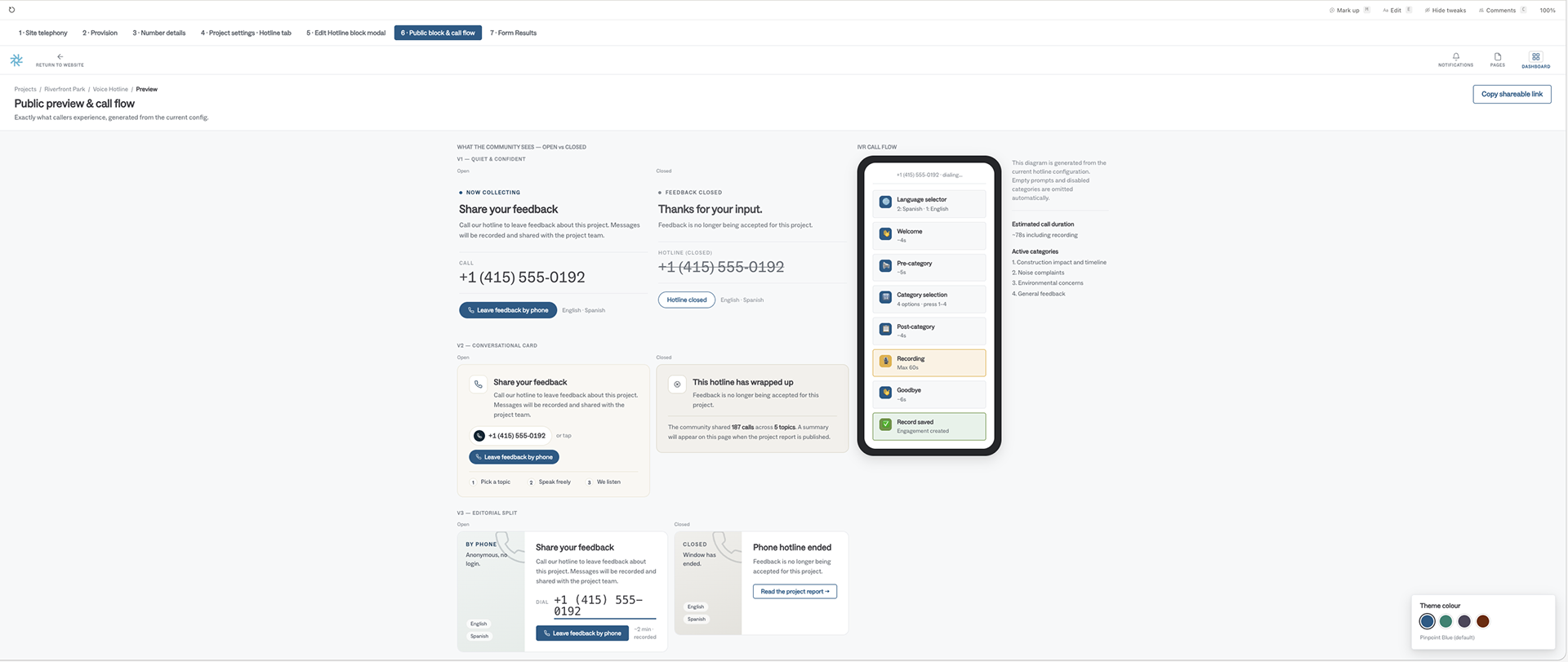
Before moving into high-fidelity design, I translated system requirements into early behavioural models and flow structures using AI-assisted exploration.
These explorations focused on how the system behaves rather than how it looks, including IVR decision trees, hotline configuration logic, multilingual routing structures, and submission lifecycle states.
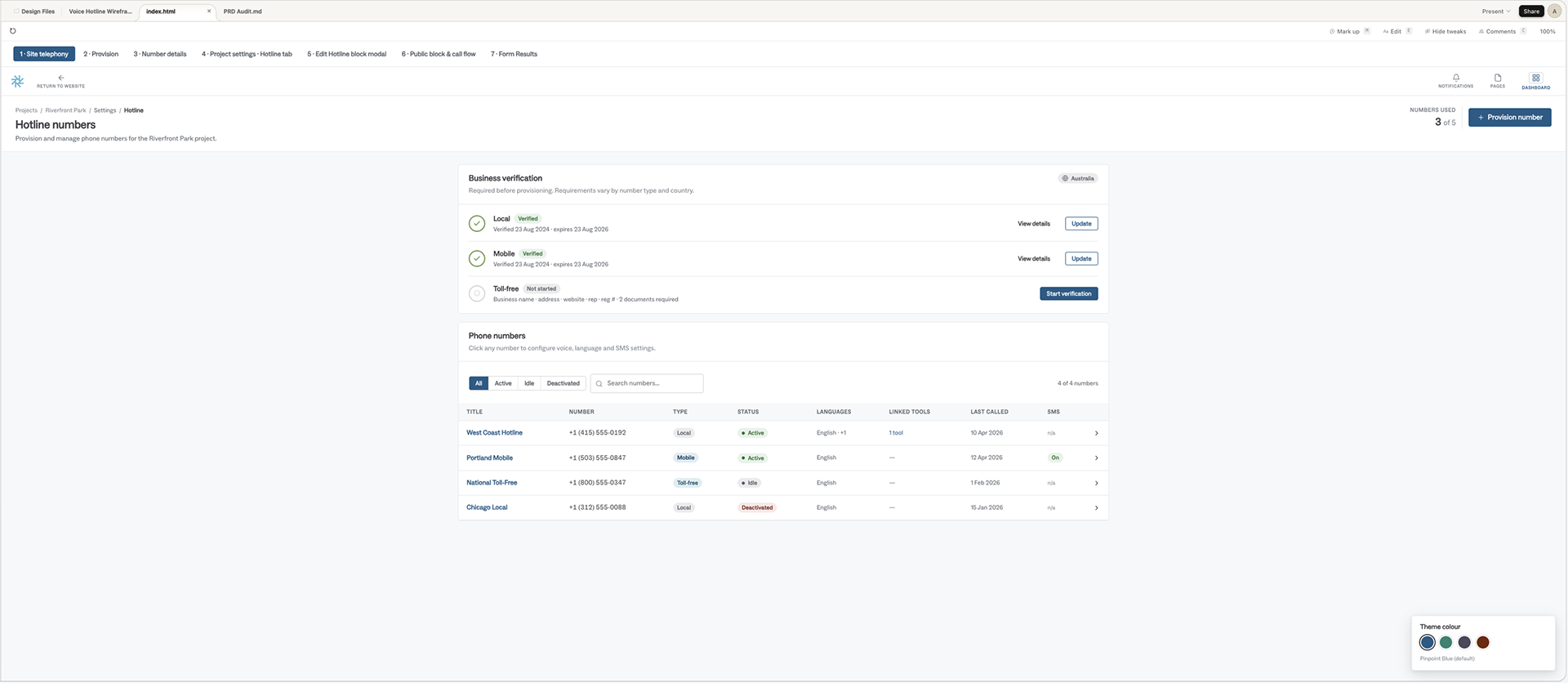
This stage was used to validate system logic early and uncover edge cases such as abandonment handling, no-input flows, linked vs original hotline inheritance behaviour, translation verification routing, and number lifecycle management.
This step ensured the architecture was stable and scalable before committing to interface design, particularly for complex government use cases with compliance and audit requirements.
Solution (High-Fidelity System Design)
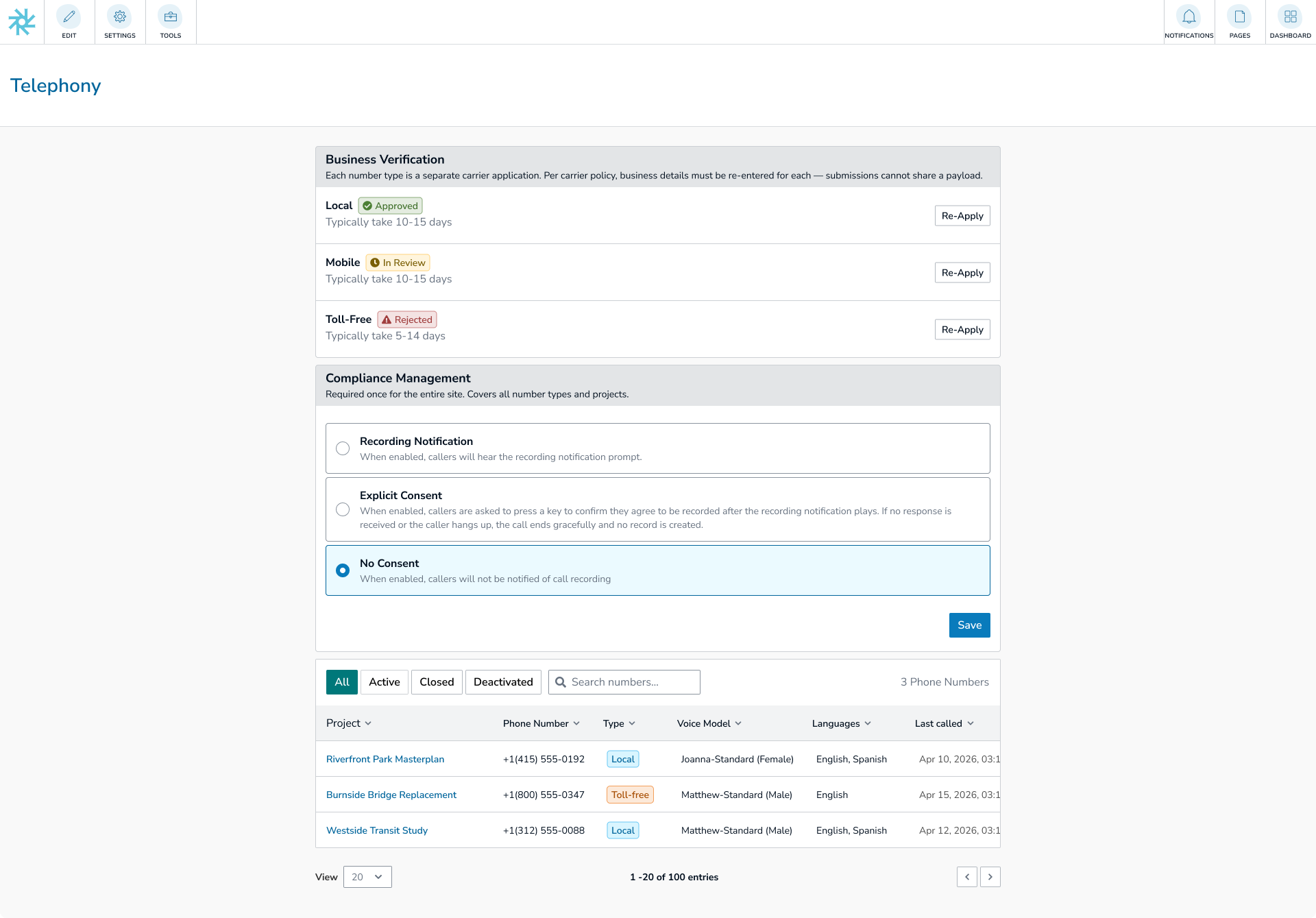
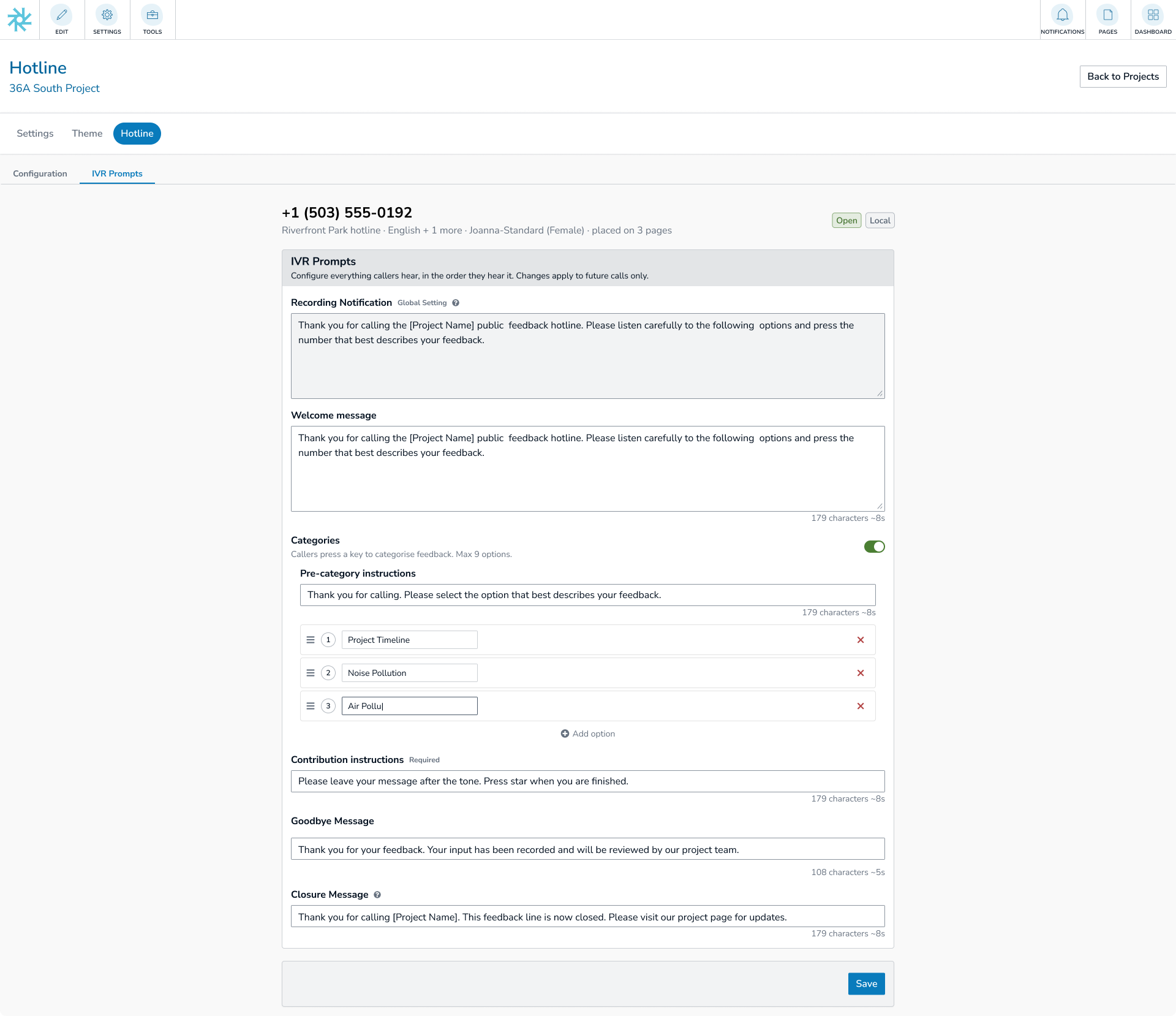
The final design introduces a phone-based IVR feedback system fully integrated into Social Point, allowing community members to leave structured voice submissions that are automatically converted into engagement records.
The experience is designed to balance simplicity for callers with complexity handled in the system layer, ensuring accessibility across diverse user groups while maintaining governance requirements for government use cases.
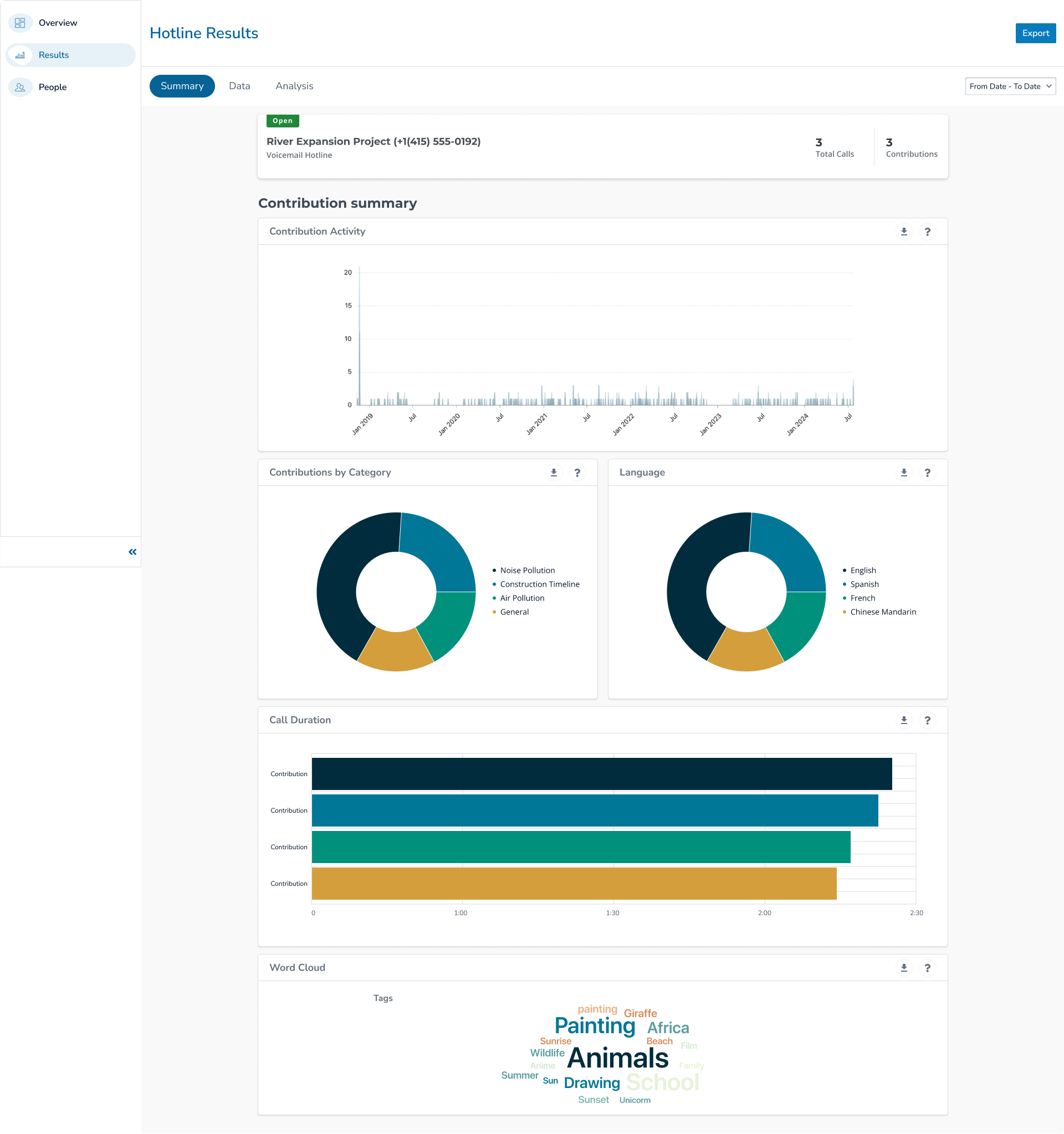
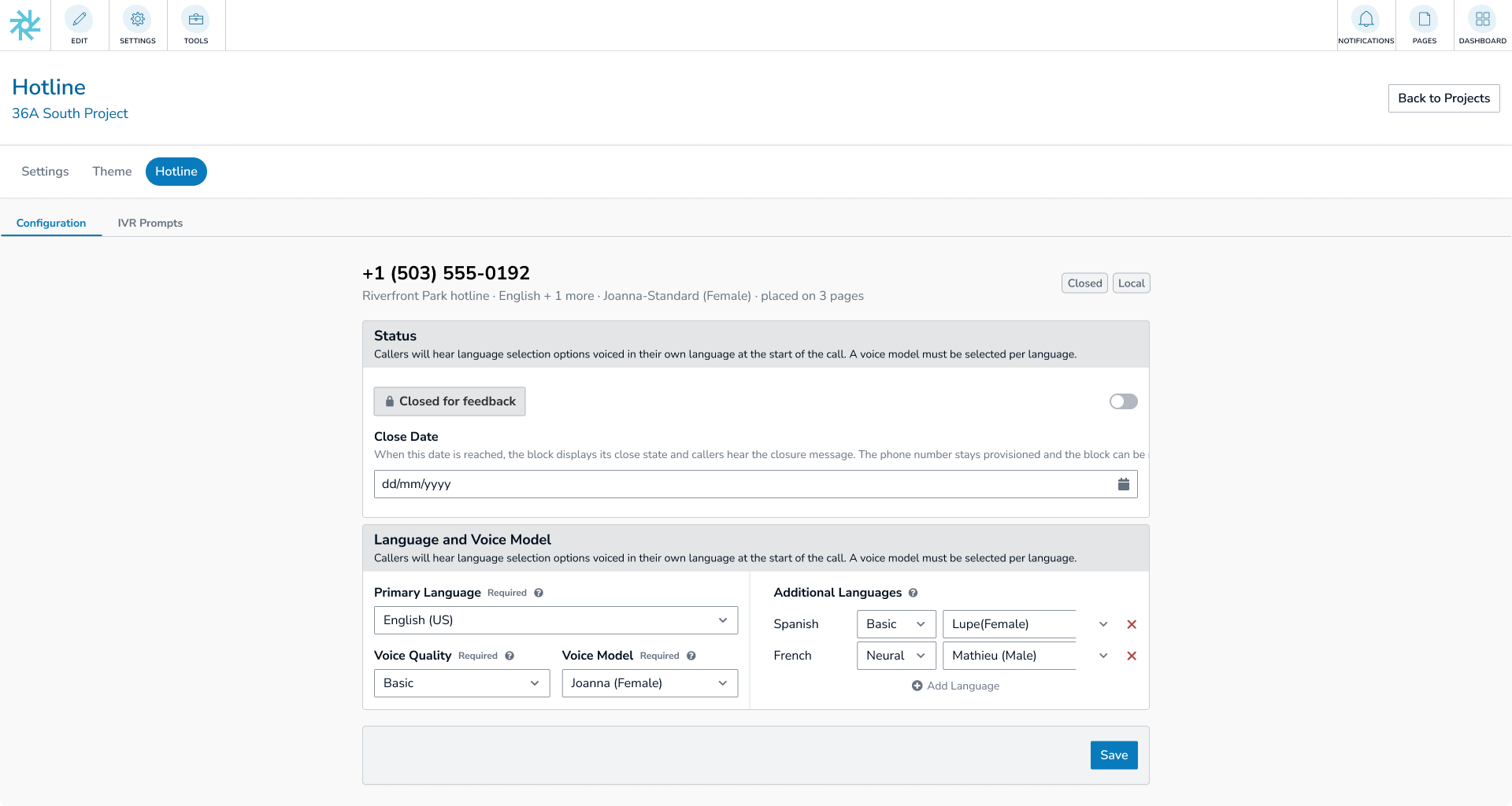
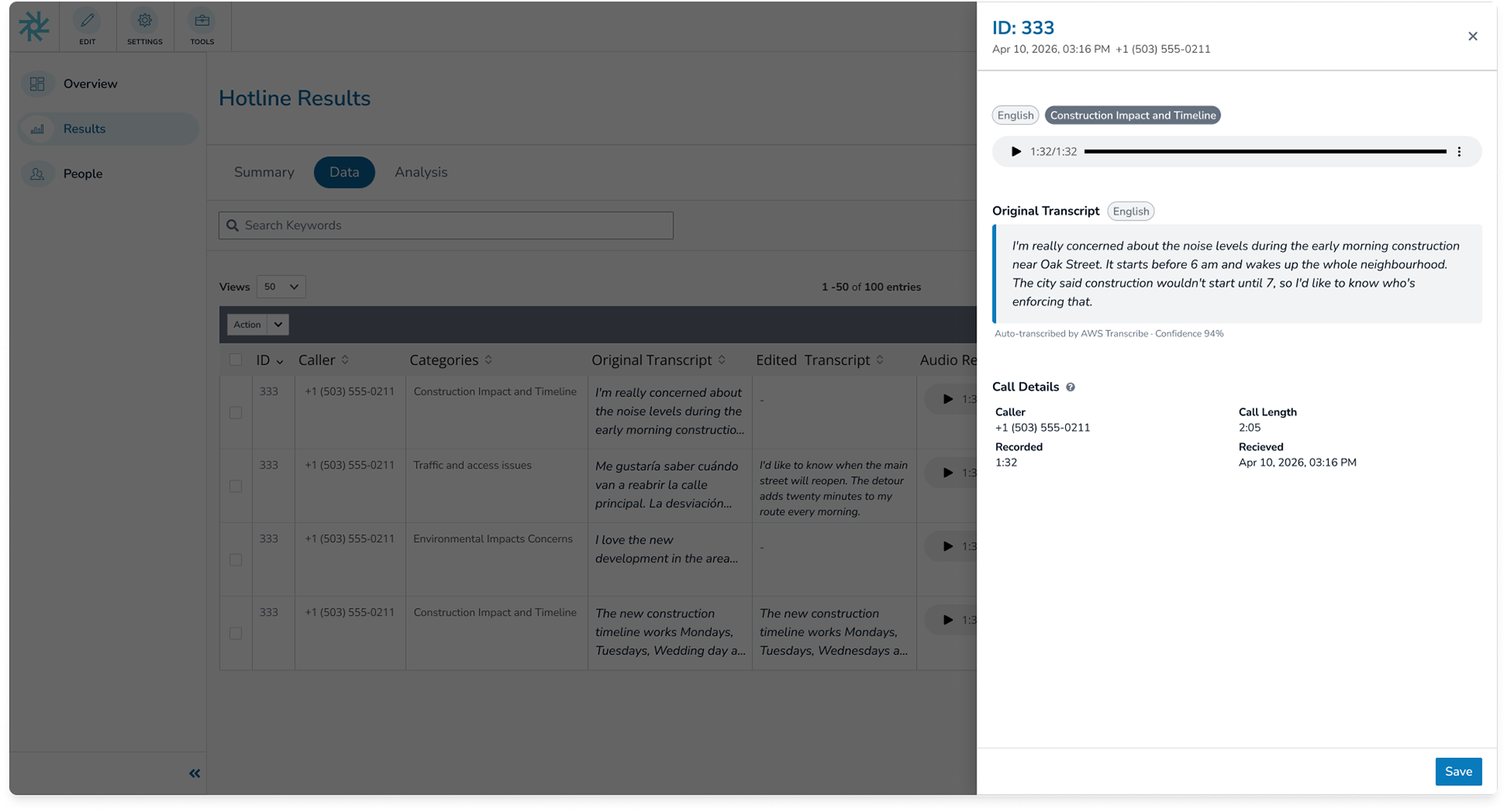
The system supports multilingual IVR flows, category-based feedback capture, and configurable prompt sequences that guide callers through structured submission. Each call is recorded as audio, transcribed, and stored alongside an editable transcript with preserved original for audit integrity.
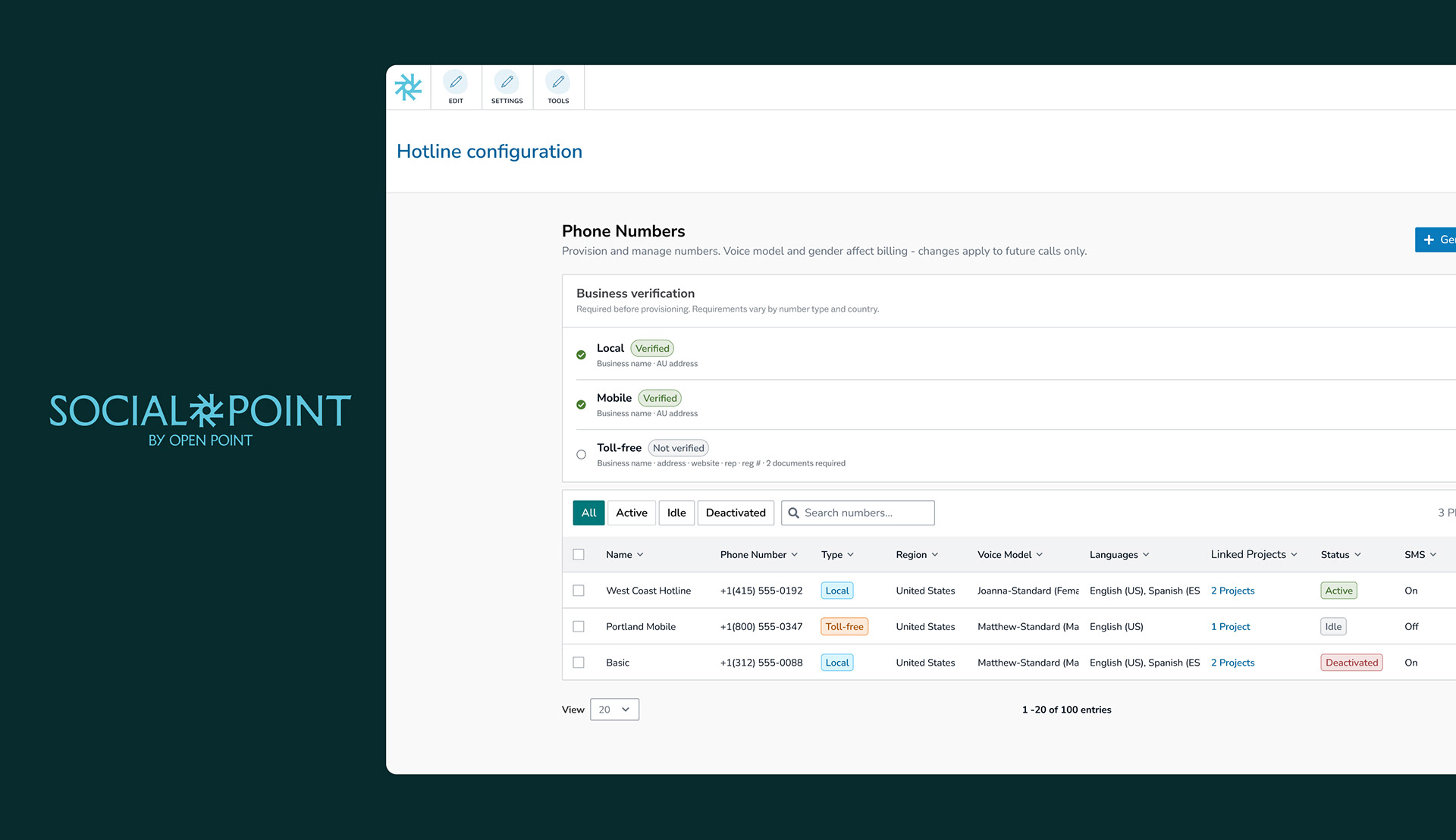
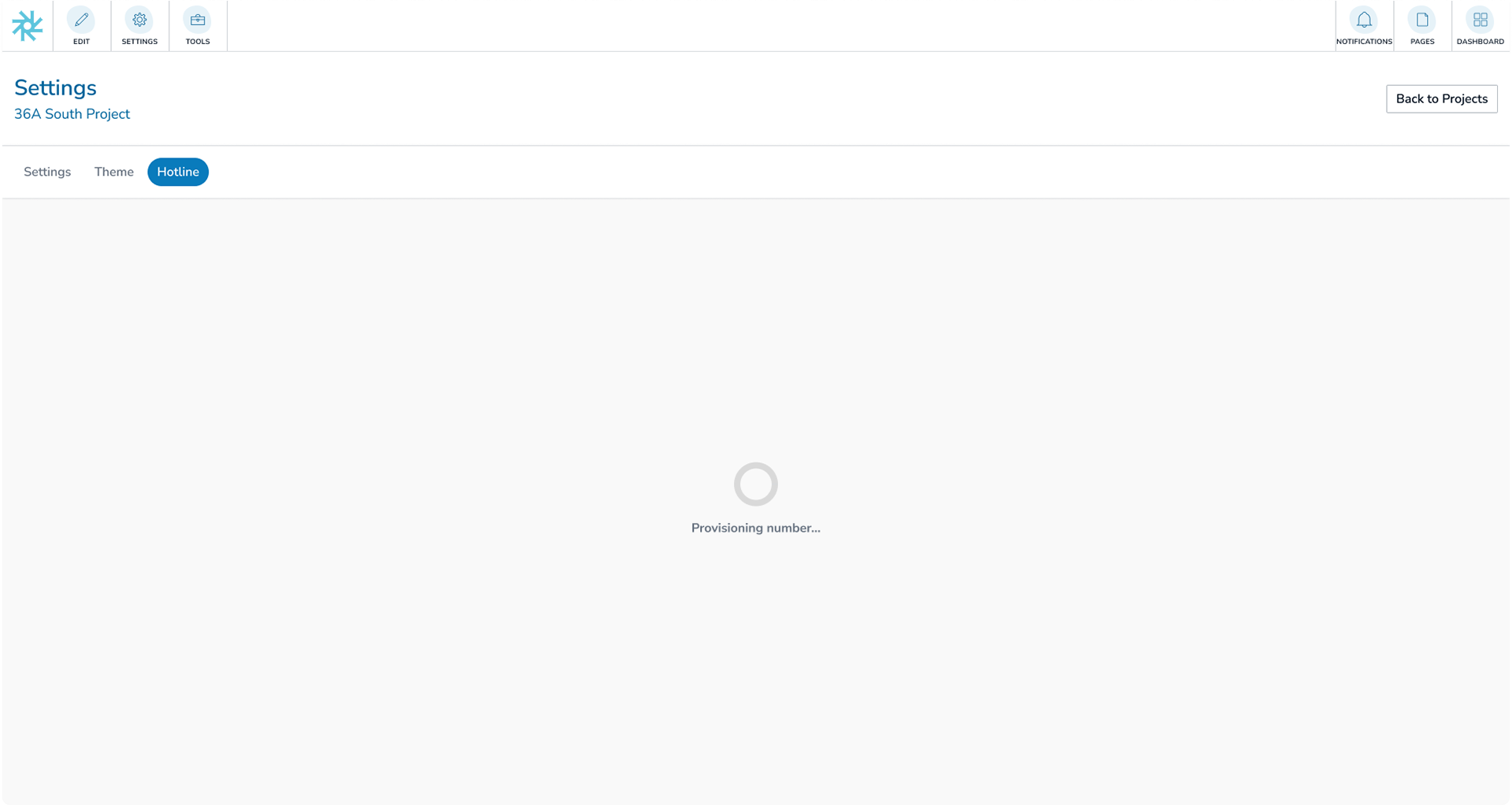
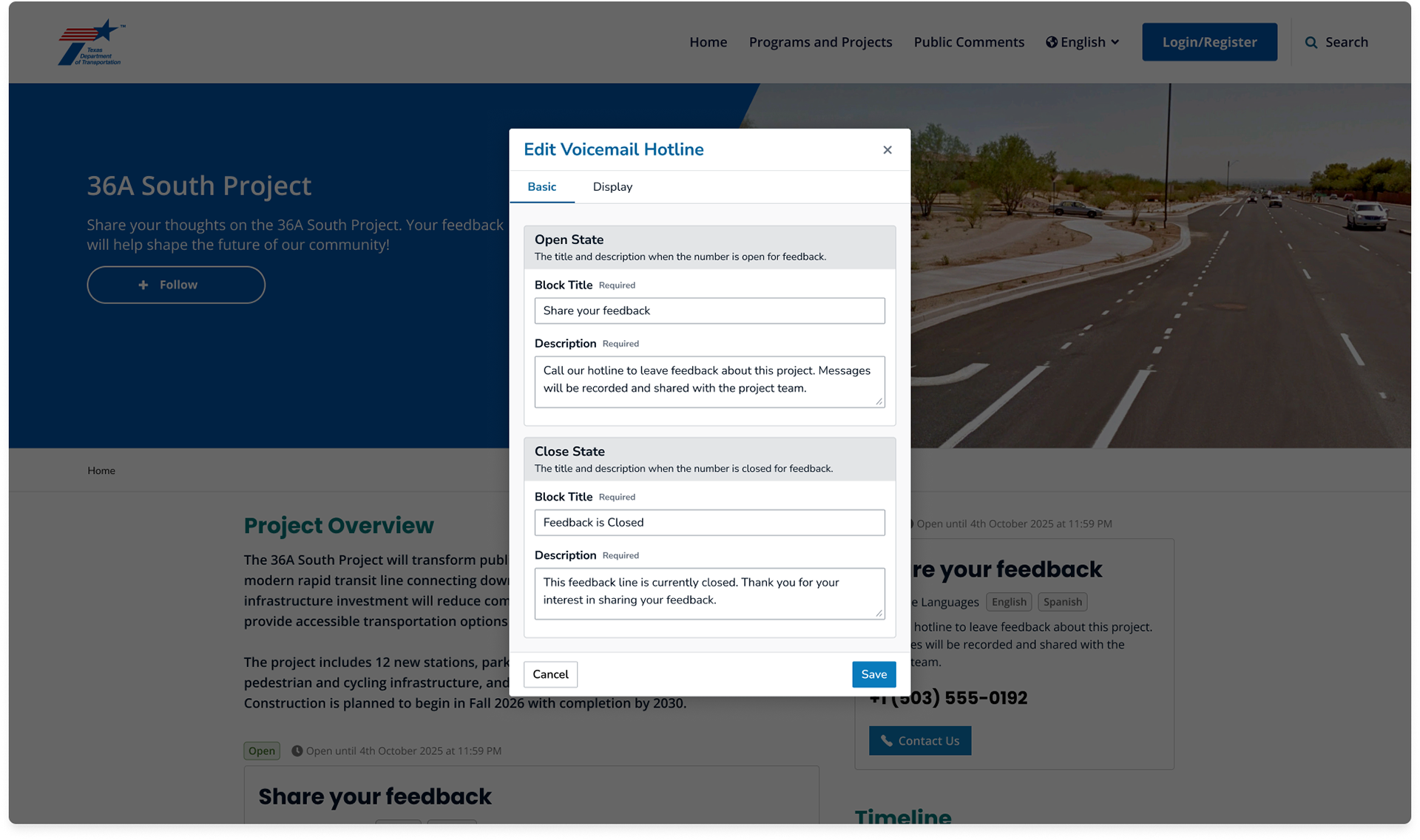
On the admin side, the system introduces project-scoped number provisioning, configurable hotline behaviour, and a linked vs original block architecture that allows reuse of the same hotline across multiple pages without duplicating configuration.
Additional system capabilities include submission ownership, reassignment between projects, and role-based access controls, ensuring feedback can be properly routed, reviewed, and actioned within large government teams.
Outcome & Reflection
This project demonstrates how I approach AI-augmented system design for complex enterprise products, not just interface design.
It resulted in a system that transforms unstructured voice calls into structured, auditable civic engagement data within a scalable enterprise SaaS platform.
It enables government agencies to capture feedback from previously underrepresented communities, while meeting strict requirements around compliance, multilingual accessibility, and auditability.
Beyond the feature itself, the key outcome was the creation of a scalable system architecture for voice-based feedback, including lifecycle management for phone numbers, structured transcription handling, and configurable workflows for submission ownership and review.
This project demonstrates how AI can be used as a design partner for system thinking, helping surface edge cases earlier, accelerate exploration of complex workflows, and shift focus from interface design to behavioural system design at scale.